

First Prize in Natural Language Processing at the NAVER AI RUSH Competition — Ahn Hwi-jin and Jung Young-hoon, Master's Students of the Natural Language Processing Laboratory
Files

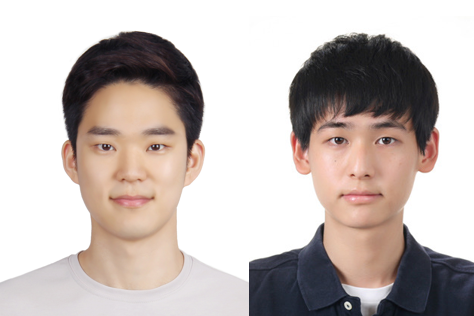
▲ (From left) Ahn Hwi-jin and Jung Young-hoon, master's students, Department of Computer Science & Engineering
Ahn Hwi-jin and Jung Young-hoon, graduate students of the Natural Language Processing Laboratory in Sogang University's Department of Computer Science & Engineering, achieved outstanding results at the NAVER AI RUSH competition. NAVER AI RUSH is an AI modelling competition hosted by Naver in which participants tackle tasks across a range of areas including natural language processing, image analysis and speech recognition. Ahn Hwi-jin and Jung Young-hoon took first place in the spam mail classification task and third place in the grammar correction task in the natural language processing category, receiving a total of 18 million won in prize money along with exemption from the document and practical test stages when applying to NAVER.
What makes their achievement especially striking is the two students' unusual background. Their first undergraduate majors were American Culture and Chinese Culture respectively at Sogang University — humanities, not engineering. They say it was thanks to Sogang University's culture of giving opportunities to students who are not computer science majors that they were able to learn the fundamentals of computing. Ahn Hwi-jin developed an interest in computer science in his final undergraduate year and took related courses, while Jung Young-hoon discovered his interest a little earlier and took related courses to the point of completing a double major.
"In the laboratory I was able to experience everything from the basics of natural language processing to research projects, and through this competition I wanted to take on real-world problems as well," said Ahn Hwi-jin of his reasons for entering AI RUSH. This year's AI RUSH was based on large volumes of data actually collected by Naver. "Facing real data there were many constraints, but knowing that the AI system I built could actually be applied in a service was a great motivation," said Jung Young-hoon.
To solve the spam mail classification task they devised an ensemble model based on CNNs, RNNs and Transformers, and used weight-based sampling to address data imbalance. For the grammar correction task they used back-translation-based data augmentation to overcome the small volume of data, and built a more general model using subword-based normalization.
References
Naver AI RUSH 2020 official website https://campaign.naver.com/airush/
Reflections on the Grammar Error Correction task (Ahn Hwi-jin) https://hwijeen.github.io/2020-08-29/AI-RUSH_1/
Reflections on the Spam Mail Detection task (Jung Young-hoon) https://boychaboy.github.io/blog/naver-ai-rush_2020/
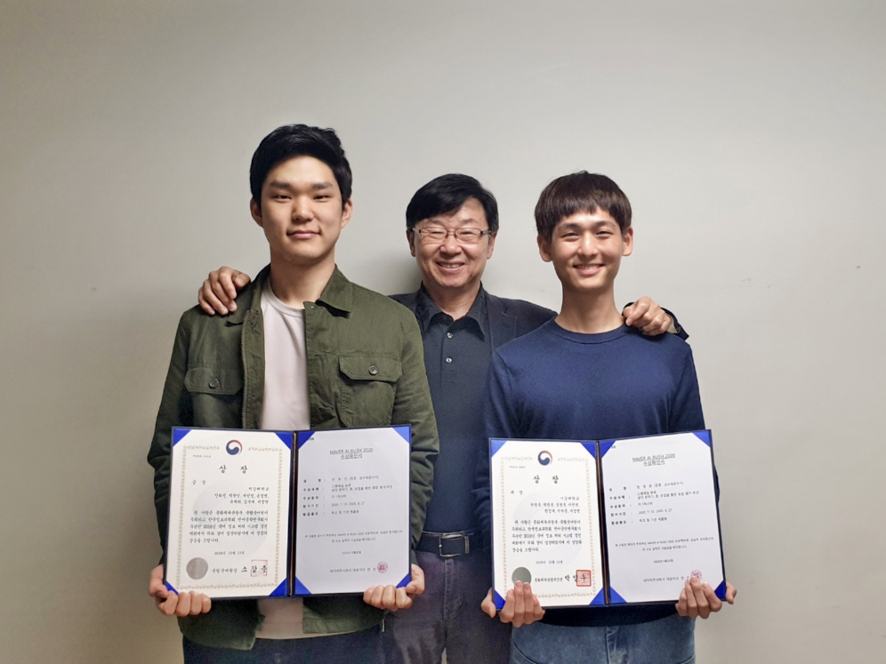
▲ (From left) Ahn Hwi-jin, master's student, Department of Computer Science & Engineering; supervisor Professor Seo Jung-yun; Jung Young-hoon, master's student
Go to the related article >>> Click https://cs.sogang.ac.kr/front/cmsboardview.do?currentPage=1&searchField=ALL&searchValue=&searchLowItem=ALL&bbsConfigFK=1749&siteId=cs&pkid=864969