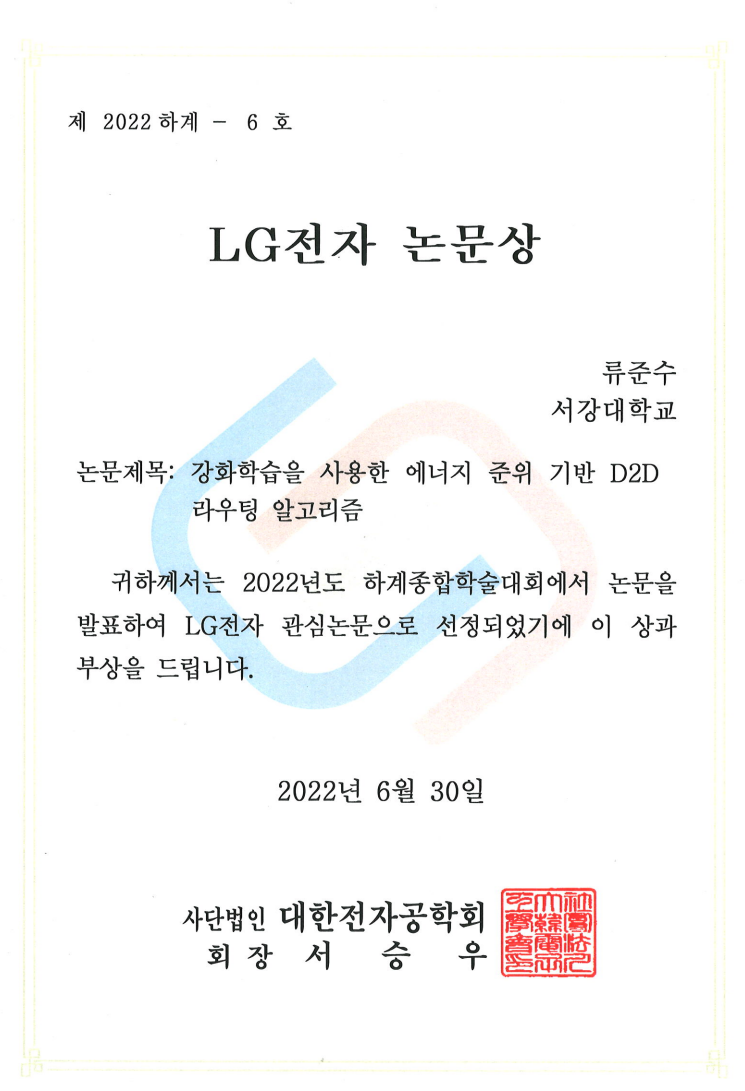
LG Electronics Paper of Interest Award at the 2022 Summer Comprehensive Conference
Files

The paper 'An Energy-Level-Based D2D Routing Algorithm Using Reinforcement Learning', written by graduate student Ryu Jun-su (first author) of the Department of Computer Science & Engineering and his supervisor Professor Kim Seung-wook (corresponding author), received the LG Electronics Paper of Interest Award at the 2022 Summer Comprehensive Conference organized by the Institute of Electronics and Information Engineers.

▲ From left: Ryu Jun-su (first author) and supervisor Professor Kim Seung-wook (corresponding author)
The Institute of Electronics and Information Engineers was founded on 26 November 1946 as the Korean Institute of Electrical Communication. After the Korean War it was renamed the Institute of Electronics Engineers of Korea, an incorporated association, in April 1963 in order to contribute to the promotion and advancement of scholarship and technology in electronics, information and communications and related fields; it launched its journal and obtained authorization as an incorporated association, and so continues today. The Institute's purpose is to carry out the activities necessary to contribute to the promotion and advancement of scholarship and technology in electronics, information, communications and related fields. Its principal activities include academic work such as domestic and international conferences, short courses, seminars and lectures; the publication of journals, magazines, books and technical information; and academic and technical research and the establishment of standards. Among these, the summer conference is a flagship conference organized annually by the Institute, at which papers are presented on a wide range of topics including communications, semiconductors, computing, AI signal processing, systems and control, and industrial electronics.
This paper proposes a routing method using reinforcement learning to reduce the burden on base stations in D2D mobile network environments by taking account of the energy levels of mobile terminals. When forwarding packets, the proposed routing method provides rewards proportional to each mobile terminal's energy level and its distance to the destination, thereby naturally inducing even energy use across the whole network. Simulation showed that the proposed method reduces the average number of hops consumed in routing compared with existing methods, and also extends the lifetime of the whole network.