

Regular Paper Accepted at the Outstanding International Conference ACM SYSTOR
Files

The research team of the Data-Centric Computing and Systems Laboratory
Paper Accepted at the Distinguished International Conference ACM International Systems and Storage Conference (SYSTOR) 2023

▶ (From left) Lee Seung-jin, master's student, Department of Computer Science & Engineering (first author); Lee Chang-gyu, combined master's–doctoral student; Professor Kim Young-jae, Department of Computer Science & Engineering (corresponding author)
The paper 'Iterator Interface Extended Key-Value SSDs for Range Queries', written by graduate students Lee Seung-jin (master's) and Lee Chang-gyu (combined master's–doctoral) of the Department of Computer Science & Engineering in the Data-Centric Computing and Systems Laboratory with supervisor Professor Kim Young-jae (corresponding author), has been accepted at the outstanding international conference ACM International Systems and Storage Conference (SYSTOR). The work was carried out as industrial and international collaborative research with SK hynix's Memory Systems Research (co-authors: Jung Woo-seok, Park In-hyuk) and Pennsylvania State University in the United States (co-author: Anand Sivasubramaniam).
The ACM International Systems and Storage Conference (SYSTOR) is a distinguished conference on computer systems, covering big data infrastructure, storage and file systems, and virtualization technology. SYSTOR is also listed as an outstanding conference in the Korean Institute of Information Scientists and Engineers' 2020 list of outstanding conferences in the software field.
The paper proposes an interface design for efficient range queries on existing key-value storage devices (KVSSD). The research points out that the existing range query interface design of KVSSDs using sorted data structures fails to take sufficient account of device characteristics, causing consistency problems and frequent NAND flash memory accesses that prevent the device's full performance from being realized. To resolve this, the paper presents a memory-efficient version management method together with index prefetching and value prefetching techniques that exploit device characteristics and key-value semantics, improving performance by up to about 7.2 times over prior work.
KVSSDs, which emerged as a way of resolving the problems of the traditional storage software stack, are next-generation storage devices that can eliminate the performance degradation caused by operating system layers such as the file system in conventional block-based SSDs. They have been actively discussed as candidates to replace the storage engines of existing databases and cloud-based object storage engines, and by applying these results to the implementation of range queries — one of the essential functions of a storage engine — faster range queries are expected.
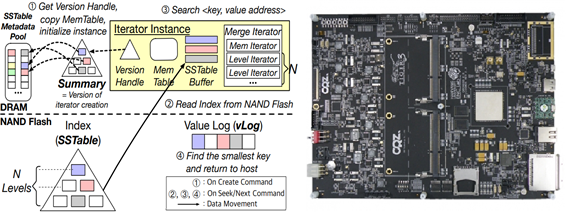
▶ The internal architecture of the key-value SSD extended with the iterator interface presented in the paper
(Figure caption: the iterator interface added to the structure of an existing LSM-tree based key-value SSD to support range queries; the paper presents the data structures and algorithms for executing range queries and storing iterator state. IterKVSSD was actually implemented on an SSD development platform board and showed throughput up to 7.2 times higher than an existing key-value SSD.)
SYSTOR 2023, organized by ACM (Association for Computing Machinery), will be held in Haifa, Israel, from 5 to 7 June.
▶ Go to the paper: https://discos.sogang.ac.kr/file/2023/intl_conf/Systor_2023_S_Lee.pdf