

Regular Paper Accepted at the Outstanding International Conference IEEE MASCOTS
Files

Paper Accepted at the Distinguished International Conference IEEE International Symposium on the Modeling, Analysis, and Simulation of Computer and Telecommunication Systems (MASCOTS)
(First author: Park Yeo-hyun; corresponding author: Professor Kim Young-jae)

▲ (From top left) Park Yeo-hyun, master's student, Department of Computer Science & Engineering; Park Jun-hyuk, undergraduate researcher; Dr Awais Khan (now at Micron Technology, Austin, TX, USA; supervisor Kim Young-jae),
Park Jung-hwan, master's student; Lee Chang-gyu, combined master's–doctoral student; Professor Kim Young-jae, Department of Computer Science & Engineering
The paper 'OctoKV: An Agile Network-Based Key-Value Storage System with Robust Load Orchestration', written by graduate students of the Data-Centric Computing and Systems Laboratory in the Department of Computer Science & Engineering — Park Yeo-hyun (master's), Park Jun-hyuk (undergraduate researcher), Dr Awais Khan (doctoral graduate), Park Jung-hwan (master's) and Lee Chang-gyu (combined master's–doctoral) — with supervisor Professor Kim Young-jae (corresponding author), has been accepted at the outstanding international conference International Symposium on the Modeling, Analysis, and Simulation of Computer and Telecommunication Systems (MASCOTS). The work was carried out in collaboration with SK hynix's Memory Systems Research.
The International Symposium on the Modeling, Analysis, and Simulation of Computer and Telecommunication Systems (MASCOTS) is a distinguished conference on the modeling and performance analysis of computer systems and networks. MASCOTS is listed at an adjusted IF of 2 among the outstanding international conferences in computer science under BK21, and as an outstanding conference in the Korean Institute of Information Scientists and Engineers' 2020 list of outstanding conferences in the software field. This year it will be held at Stony Brook University in New York, United States, from 16 to 18 October.
A disaggregated storage environment, in which storage nodes are separated from client nodes, is an approach now widely used in data centres. In such environments, however, research into adopting a key-value interface for network storage such as SAN and NAS has been lacking, so excessive I/O stack overhead arises from OS layers such as the file system. The paper proposes a new system configuration that resolves this problem, presenting a new paradigm for future research.
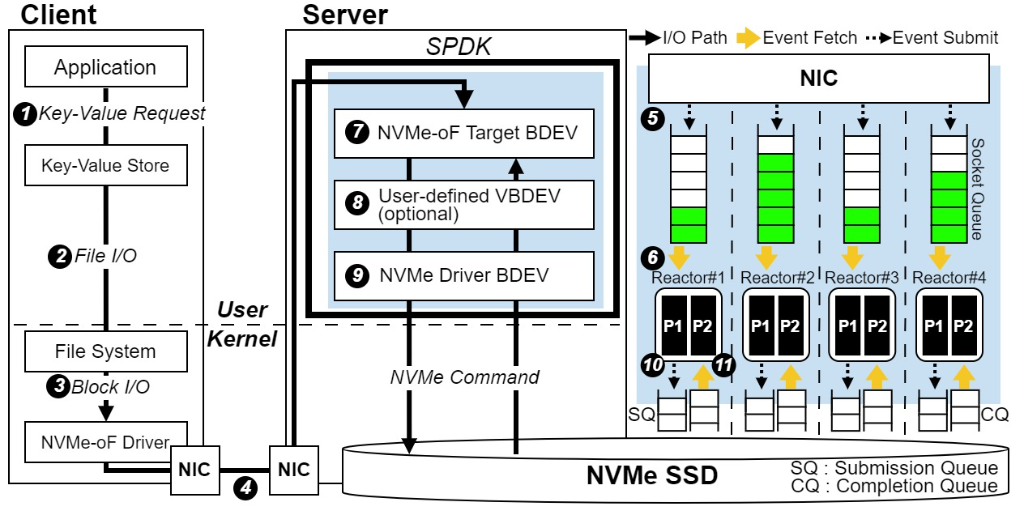
▲ The configuration of network-based block storage using SPDK
(Figure caption: the structure of network-based block storage using SPDK on the storage node, together with the detailed operation of SPDK. SPDK running on the server processes I/O by alternately running two pollers on a single thread per core.)
The paper proposes OctoKV, an innovative network-based key-value storage system design. In a disaggregated storage environment, conventional key-value stores run on top of the client-side file system and incur repeated address translation overhead. To alleviate this overhead, the key-value store was implemented on the storage server side using NVMe-oF and SPDK, a user-level NVMe driver. Resource monitoring and heuristic-based load balancing techniques were also introduced to optimize I/O performance. OctoKV was deployed on a Linux cluster together with Intel SPDK and extensively evaluated. The results show that OctoKV achieves lower I/O response times than the conventional approach in which the key-value store runs on the client side. The proposed load balancing technique also distributes load effectively across cores, optimizing I/O response time.
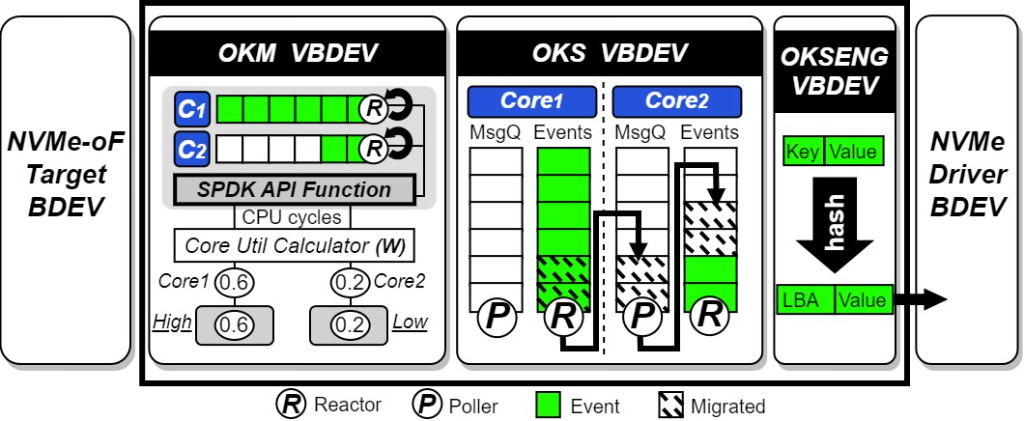
▲ Overview of OctoKV, the storage-server-based key-value store presented in the paper
(Figure caption: the storage-server-based key-value store using SPDK is implemented as an SPDK VBDEV and inserted between the NVMe-oF Target BDEV and the NVMe Driver BDEV. OKM performs imbalance monitoring and OKS resolves imbalance. OKSENG acts as the key-value store.)
The resource monitoring and heuristic-based load balancing technique for SPDK presented in the paper resolves the load imbalance that arises when the NVMe-oF Target runs on SPDK. Unlike conventional drivers, SPDK runs in user space and adopts polling and a shared-nothing architecture — a state-of-the-art design for achieving high-speed I/O. The NVMe-oF Target provided by SPDK not only consumes a great deal of CPU core utilization but is also a cause of load imbalance between CPU cores. This research therefore introduces a technique that monitors SPDK's CPU core resources and performs load balancing when imbalance occurs. Applied to SPDK independently of OctoKV, the technique is expected to be usable for optimizing I/O response time on network-based storage nodes.

▲ Analysis of the correlation between core utilization and I/O latency
(Figure caption: a graph plotting the processing time of I/O within SPDK (I/O latency) against the core utilization of the core that processed that I/O, when SPDK uses six cores to process I/O. The experiments demonstrate that as the volume of I/O grows the cores split into two groups, and that I/O processed by the group with relatively high core utilization has higher I/O latency.)
Conference link: https://mascots.iitis.pl
Go to the paper: https://discos.sogang.ac.kr/file/2023/intl_conf/MASCOTS_2023_Y_Park.pdf