

Nurturing Convergence Talent through Educational Innovation Centred on Semiconductors and AI/SW
Files

Sogang University
Selected for the Advanced Industry Specialized University Programme
New 'Next-Generation Semiconductor Interdisciplinary Major' from next year
Additional School of Liberal Studies based on AI, and more
Strengthening the creative AI/SW convergence education system
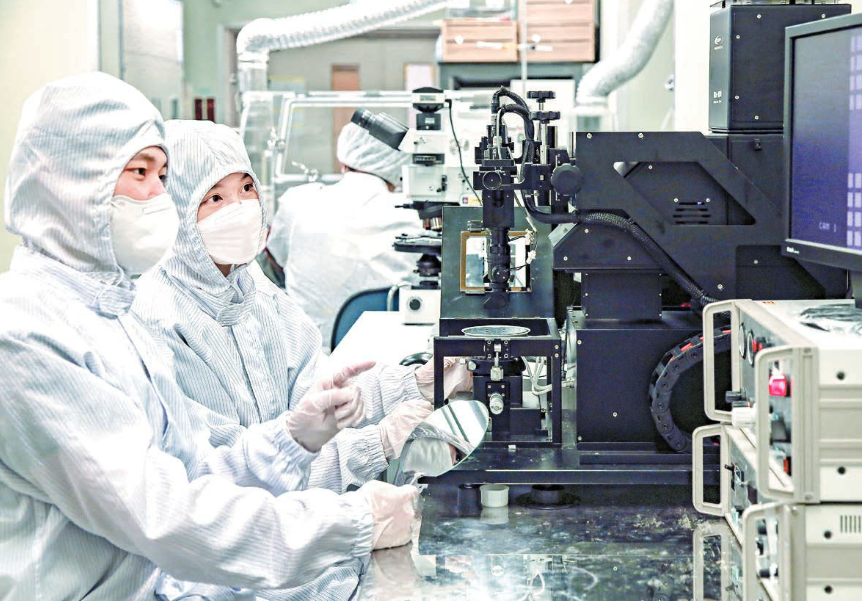
Sogang University is nurturing convergence talent to lead advanced industry, centred on the two pillars of semiconductors and artificial intelligence (AI)/software (SW). It plans to lead the core technologies of the era of digital transformation and establish itself as a leading research and education hub in Korea. [Photo: Sogang University]
Sogang University is nurturing convergence talent to lead advanced industry through educational innovation centred on the two pillars of semiconductors and artificial intelligence (AI)/software (SW).
Nurturing semiconductor specialists to achieve an unassailable lead
In July Sogang University was selected for the Advanced Industry Specialized University support programme. In line with the government's vision for the semiconductor specialization programme — 'nurturing semiconductor specialists who will secure an unassailable lead' — the University is making a range of efforts to nurture 'ELITE (Excellent Leaders & Industry Technology Experts)' talent by applying its own distinctive approach to education.
The curriculum has been substantially expanded. From the second semester of 2024 a 'Next-Generation Semiconductor Major Track' has been established within the Department of Electronic Engineering, designed so that students majoring in electronic engineering take an additional 27 credits of semiconductor-related courses. This will nurture electronic engineering talent with semiconductor expertise.
From 2025 a 'Next-Generation Semiconductor Interdisciplinary Major', made up of semiconductor-related courses from the Departments of Electronic Engineering, Computer Science & Engineering, Mechanical Engineering, Chemical and Biomolecular Engineering and Physics, will be established, broadening the scope of convergence education in semiconductors. The interdisciplinary major comprises 36 credits of semiconductor-related courses in total. In 2026 a 'Department of Semiconductor Engineering' will be established, completing the educational system for nurturing semiconductor specialists.
The physical environment for semiconductor education is also being improved on a large scale. Process/device and design/systems have been selected as the University's semiconductor specialization fields in pursuit of an unassailable lead, and in this first year of the programme the aim is chiefly to lay the infrastructure for educational activities. More than 2.5 billion won is being invested in improving existing educational infrastructure and building new laboratories. A semiconductor measurement laboratory will be built in the Rich Science Hall (Building R) and equipped with measurement instruments such as high-power parameter analysers and array measurement systems for use in practical classes.
As process education infrastructure, a new semiconductor process laboratory with CMOS standard process facilities is planned for the POSCO Francisco Hall (Building F). After the infrastructure for specialized semiconductor education is laid, it will be supported through use and improvement so that it can be upgraded and established. The University will also secure the latest design tools available to all students to strengthen practice-oriented design education, and plans to run two weeks of intensive design tool training during the 2024 winter vacation.
Sogang University is making a range of efforts to nurture field-ready industrial technology specialists in cooperation with more than 30 companies. It is strengthening industry-academic activities in cooperation with SK hynix, DB HiTek, LG Electronics and Samsung Display, and in November it held an industry advisory council meeting and results-sharing session at L Tower in Yangjae-dong, where it held a panel discussion on university semiconductor education in the AI era with 25 industry representatives and industry-academic managers from 17 companies including SK hynix and Synopsys, and heard advice on specialized education.
Nurturing AI/SW specialists for the era of digital transformation

Sogang University was selected for phase 2 of the Software-Oriented University support programme and will nurture core SW talent grounded in AI.
Having first established a Graduate School of Artificial Intelligence as an interdisciplinary programme in 2022, Sogang University established an undergraduate Department of Artificial Intelligence in 2023 and began nurturing AI specialists in earnest. It was selected for phase 1 of the Software-Oriented University support programme, which began in 2015 to nurture software talent, and in 2024 it was also selected for phase 2, launched to nurture core software talent grounded in artificial intelligence for the era of digital transformation. This has laid the foundations for nurturing convergence AI/SW specialists who will lead advanced industry.
For creative software major and artificial intelligence convergence education, the University established a 'College of Software Convergence' in 2024 and placed the Department of Computer Science & Engineering, the Department of Artificial Intelligence and the Graduate School of AI·SW within it. From 2025 it will additionally establish a 'School of Liberal Studies based on AI' to further strengthen the system for nurturing convergence talent. For education in priority emerging technology fields it has also created educational programmes in seven specialization areas: blockchain, cloud, on-device AI, generative AI, entertainment, financial AI and AI semiconductor software.
Compulsory education in the fundamentals of artificial intelligence has also been expanded: from the introductory stage, which begins with 'Introduction to AI Programming' as a required general education course, through the extension, advanced and application stages, a total of 9 credits is offered. The University has also decided to run a curriculum and PBL-based practical courses to strengthen capability across the full software development life cycle. It has established tracks in priority emerging technology fields and developed some 30 new courses for use in emerging technology education. To help nurture super-experts, it is also building a practical training environment for cloud-based software development processes using open source.
The emerging technology convergence curriculum, in which every non-software department takes part, will comprise 25 AI/SW convergence tracks, 7 AI/SW convergence interdisciplinary majors and 19 AI/SW convergence micro-majors. In particular, 'AI Convergence Capstone Design', in which students tackle real industry problems, has been designated a common required course taken jointly by students from software and non-software departments in order to contribute to nurturing convergence talent. An undergraduate research institute will also be established and operated for undergraduates to pursue autonomous creative research in AI convergence.
LG Electronics and leading small and medium-sized IT companies support tuition for students entering the master's programme of the Department of Artificial Intelligence and provide living costs and other scholarships on the condition of employment, while Smilegate and a number of companies provide living costs and scholarships. Students entering the undergraduate Department of Artificial Intelligence receive scholarships covering the admission fee and 50% of tuition.
Lee Jun-hyuk, JoongAng Ilbo M&P reporter, lee.junhyuk1@joongang.co.kr
[Source: JoongAng Ilbo] https://www.joongang.co.kr/article/25302380