

Regular Paper Accepted at the Top International Conference ACM International Conference on Information and Knowledge Management (CIKM) 2025
Files

Top International Conference
ACM International Conference on Information and Knowledge Management (CIKM) 2025
Regular Paper Accepted

▶ Lee A-hyun, doctoral student
The paper 'D-HAT: Dynamic Hypergraph Representation Learning with Attention-Based Multi-Level Hypergraph Sampling', written by doctoral student Lee A-hyun of the Machine Learning Systems Laboratory (MLSys) (first author) and Professor Moon Eui-hyun (corresponding author), has been accepted for publication at the ACM International Conference on Information and Knowledge Management (CIKM) 2025.
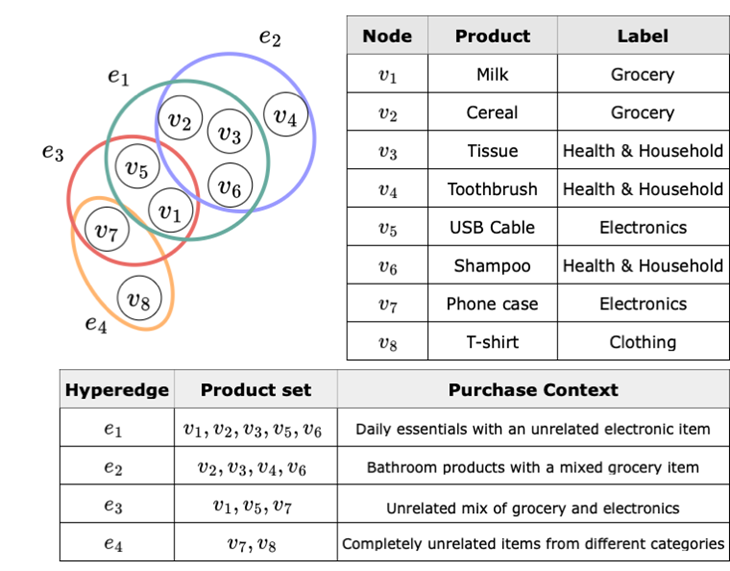
▶ Figure 1. An example of a hypergraph. Unlike conventional graphs based on binary relations, which can express only connections between two entities, a hypergraph expresses high-order interactions (HOI) among three or more entities simultaneously as hyperedges, with the advantage of preserving many-to-many relationships.
Hypergraph neural networks (HNNs) can effectively capture multi-party relationships that conventional graphs cannot express, and are therefore attracting attention in a variety of fields including recommender systems, natural language processing and computer vision. Training directly on a large hypergraph, however, is computationally and memory intensive, so sampling techniques that construct efficient sub-hypergraphs while preserving the structural properties of the original graph are essential. Existing node-based or hyperedge-based sampling methods are limited in that randomness can disconnect the subgraph, or that treating the importance of all neighbours equally causes information loss.
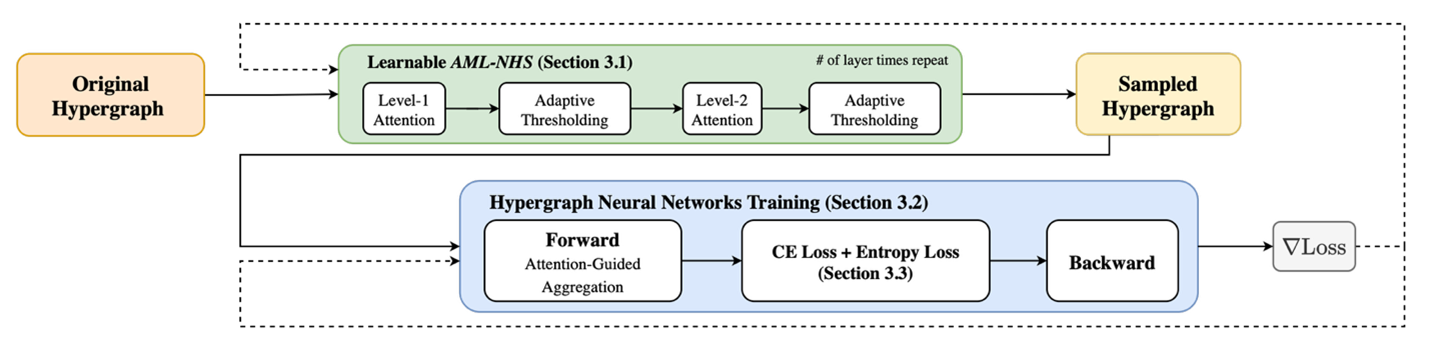
▶ Figure 2. Architecture of the D-HAT framework.
To resolve these limitations, this research proposes D-HAT, an attention-based multi-level sampling framework that dynamically selects meaningful neighbouring nodes and hyperedges during training. The proposed technique consists of three main stages. (1) Node→hyperedge attention (level-1 attention) evaluates the importance of connected hyperedges, and adaptive thresholding selects the important ones. (2) Hyperedge→node attention (level-2 attention) is then applied to select the important nodes. (3) This process is repeated hierarchically to form a progressively more representative sub-hypergraph. Within the hypergraph neural networks (HNNs), attention-guided aggregation emphasizes the contribution of important neighbours, and dense skip connections were introduced to compensate for information that may be lost during sampling. Finally, an entropy regularization loss was added to keep the model from focusing excessively on particular neighbours and to make it consider a variety of candidates, securing stability in training.
In experiments, D-HAT improved accuracy on real datasets such as Cora, PubMed and 20News by up to 15.85% over node sampling and 5.49% over hyperedge sampling. It recorded the highest performance even on extreme structures made up of a small number of huge hyperedges, such as 20News, by effectively selecting meaningful neighbours.
The ACM International Conference on Information and Knowledge Management (CIKM) is a distinguished conference on data mining and artificial intelligence. CIKM is listed at an adjusted IF of 3 among the outstanding international conferences in computer science under BK21, and as a top conference in the Korean Institute of Information Scientists and Engineers' 2024 list of outstanding conferences in the software field. This year it will be held at COEX in Seoul from 10 to 14 November.
References:
CIKM2025 Website : https://cikm2025.org