

Professor Choi Jun-seok's Research Team Has a Regular Paper Accepted at the Top International Conference NeurIPS (The Thirty-Ninth Annual Conference on Neural Information Processing Systems) 2025
Files

The Thirty-Ninth Annual Conference on Neural Information Processing Systems (NeurIPS 2025)

(From left) Professor Choi Jun-seok; Hwang Dong-jun, doctoral student; Kim Ye-jin, master's student; Lee Min-young, doctoral student
Research on a sustainable open-vocabulary segmentation (OVS) model carried out by Professor Choi Jun-seok's research team (Hwang Dong-jun, doctoral; Kim Ye-jin, master's; Lee Min-young, doctoral) has been accepted at Neural Information Processing Systems (NeurIPS 2025). NeurIPS is a globally prestigious conference in artificial intelligence, registered as a BK outstanding international conference (recognized IF 4.0), and will be held in San Diego, United States, and Mexico City from 30 November to 7 December.
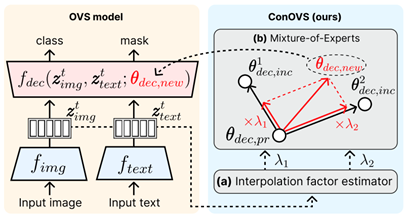
The paper, titled 'OVS Meets Continual Learning: Towards Sustainable Open-Vocabulary Segmentation', points out that when additional training data becomes available, existing fine-tuning, retraining and continual learning approaches do not sufficiently extend the recognition capability of OVS models. It also notes that, unlike foundation models pre-trained on large-scale data, current OVS models do not perform well enough to be used as they are.
To resolve this, the team proposes ConOVS, a continual learning framework for OVS. ConOVS uses a mixture-of-experts strategy that dynamically merges decoder weights according to the input sample. Each time a new dataset is added, the decoder is lightly fine-tuned, and weight interpolation/merging between the original model and the expert decoder is performed per sample, extending capability without performance degradation.
In experiments ConOVS consistently outperformed a range of comparison methods. In particular, the team observed that as datasets were progressively expanded, performance also improved on zero-shot test sets containing classes not included in training. This shows that continual expansion can strengthen rather than harm generalization performance.
Aimed at the practical limitations of OVS, the research presents a training procedure that simultaneously considers the ability to absorb additional data, cost efficiency and generalization. It is expected to provide a direct reference point for building sustainable OVS in industry and academia.
- Conference page: https://neurips.cc/
- Paper link: https://arxiv.org/abs/2410.11536
- Code link: https://github.com/dongjunhwang/ConOVS