

Regular Paper Accepted at the Outstanding International Conference, The IEEE International Symposium on Cluster, Cloud, and Internet Computing (CCGRID 2026)
Files

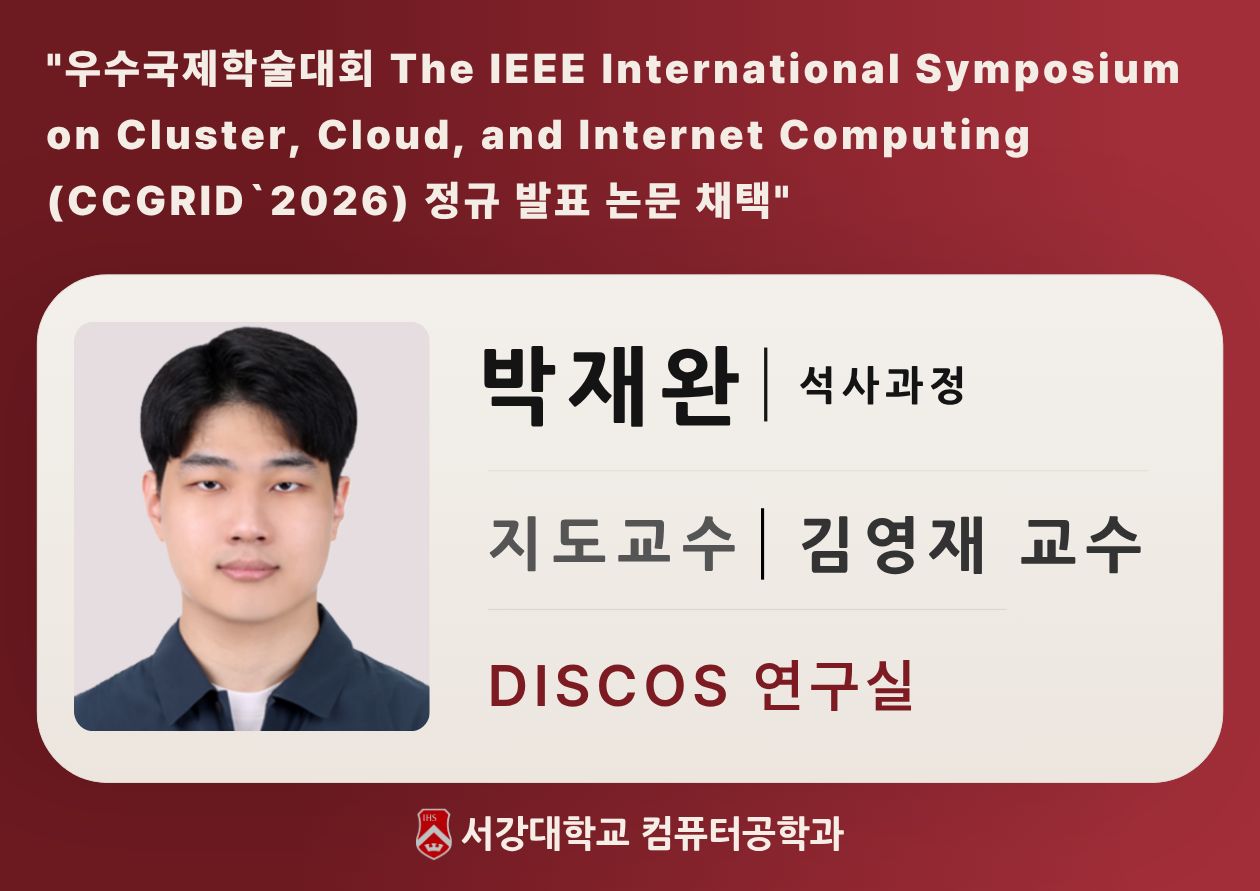
The paper 'BucketLSM: Breaking the Compaction Scalability Barrier in LSM-Based Key-Value Stores', written by Park Jae-wan, master's student at the Data-Centric Computing and AI Systems Laboratory (DISCOS) (first author; supervisor Professor Kim Young-jae), Min Kyung-wook (master's), Byeon Seong-jin (master's), Noh Tae-wan (master's), Park Hyun-gi (undergraduate researcher) and Professor Kim Young-jae (corresponding author), has been accepted for publication at the IEEE International Symposium on Cluster, Cloud, and Internet Computing (CCGrid 2026). A total of 247 papers were submitted this year, of which 62 were accepted as long regular papers (acceptance rate 25.1%).
Today's cloud services, search engines, databases and artificial intelligence systems all run on key-value storage systems that store and process vast amounts of data quickly. LSM-tree based storage systems such as RocksDB likewise store data simply as key-value pairs for fast storage and processing, but when writes pile up, sudden delays and performance degradation recur because of data reorganization work.
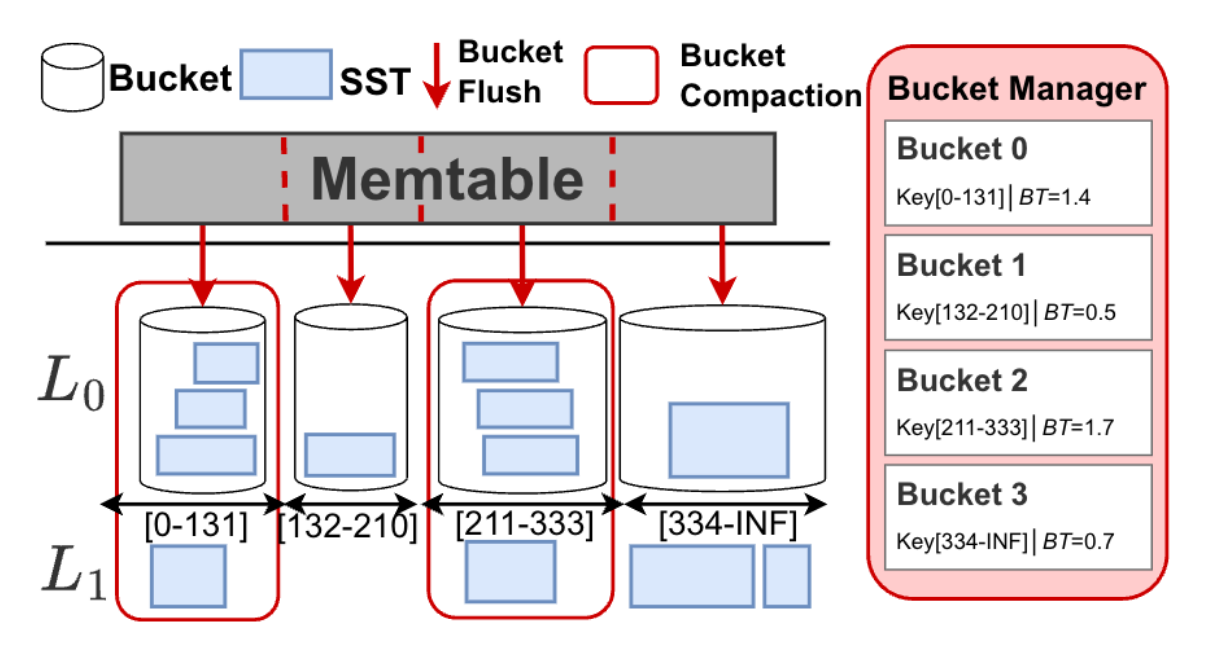
Figure 1. Architecture overview of BucketLSM
The research showed that the cause of the recurring performance degradation in large-scale LSM-tree based data storage systems is not simply a shortage of resources but a structural limitation at Level-0, where data is first stored on disk. To resolve this, the team proposed BucketLSM, a new storage structure that divides Level-0 into several independent buckets, designed so that reorganization work can be performed in parallel from the earliest stage of data storage.
In the experiments BucketLSM improved write throughput by up to 2.6 times over existing RocksDB, greatly reduced write stalls — a major cause of system performance degradation — and kept read latency stable even under heavy write loads, demonstrating its practical effectiveness in large-scale data processing environments. By redesigning the LSM-tree storage structure itself rather than merely tuning performance, the research fundamentally extends parallelism and points to a direction broadly applicable in real industrial settings such as cloud infrastructure, large-scale databases and AI service backends.
Park Jae-wan, the paper's first author and a master's student, said: "I began this research from the conviction that the performance problems of LSM-trees are hard to solve through implementation optimization alone and require structural redesign. BucketLSM pinpoints the bottleneck of existing systems and shows a way to extend parallelism structurally.
I want to continue systems architecture research that can deliver meaningful performance improvements in real large-scale storage systems. It is also a field where you can see first-hand how the data structures, operating systems and systems concepts learned in class connect to real industrial problems."
IEEE CCGRID is a conference that aims to exchange fundamental advances and real-world applications in cloud computing, distributed systems, high-performance computing and artificial intelligence, to identify new research topics and to define the future of cloud computing. This year's event will be held in Sydney, Australia, from 18 to 21 May.
[References]
The 26th IEEE International Symposium on Cluster, Cloud, and Internet Computing (CCGRID`2026)
Website : https://ccgrid2026.cdms.westernsydney.edu.au/