

Regular Paper Accepted at the Top International Conference ACM International Conference on Information and Knowledge Management (CIKM) 2026
Files

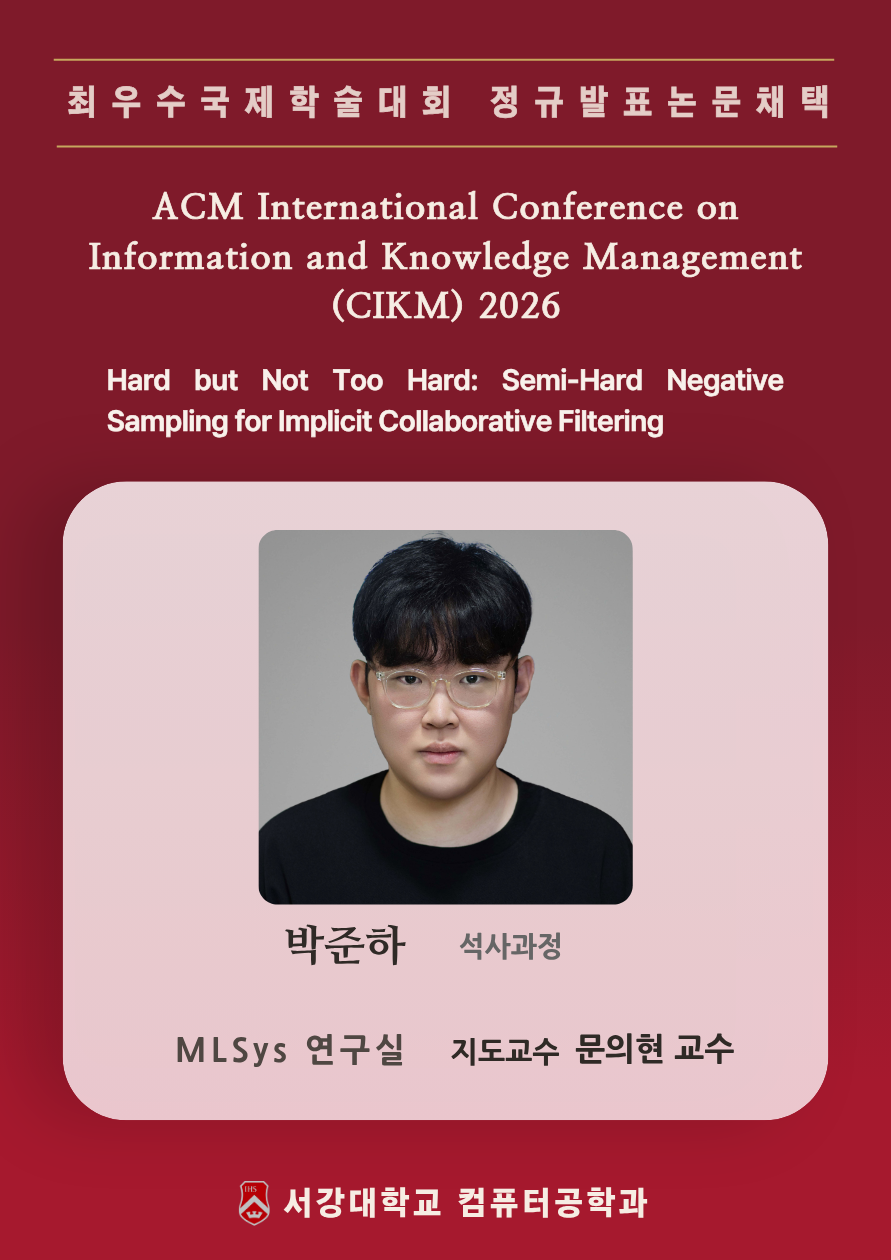
The paper 'Hard but Not Too Hard: Semi-Hard Negative Sampling for Implicit Collaborative Filtering', written by Park Jun-ha (master's, first author), Choi Se-yeon (master's), Professor Yang Ji-hoon and Professor Moon Eui-hyun (corresponding author) of the Machine Learning Systems Laboratory (MLSys), has been accepted for publication at the top international conference ACM International Conference on Information and Knowledge Management (CIKM) 2026 (acceptance rate: 597/2216 = 26.9%).
A recommender system learns a user's taste from their past behaviour to predict and offer items they are likely to prefer. Training a recommendation model based on a pairwise loss requires records of both preferred and non-preferred items. The data collected in real services, however, is mostly implicit feedback such as clicks or purchase history, which reveals preference only indirectly, so only records of what the user liked exist. Some of the vast number of items with no observed interaction must therefore be taken as non-preferred items — negative samples — for training, which raises the need for an effective way of choosing them.
Existing research has widely used hard negative sampling, which selects as negative samples the items to which the model assigns high preference scores. This has the limitation that it also increases the risk of false negatives — the possibility that the selected item is in fact one the user prefers. Moreover, most existing techniques are designed from empirical observation, and negative sampling distributions derived from theoretical analysis of the loss function have not been sufficiently studied.
To resolve these limitations, the team analysed implicit collaborative filtering in depth under the Bayesian Personalized Ranking (BPR) loss and derived the optimal negative sampling distribution that maximizes an approximation of Recall@K, a representative recommendation quality metric. They established theoretically that items within the top-K preference region should have a low probability of being selected as negative samples, while moderately preferred items outside that region should in fact be selected more often.
On the basis of this analysis the team proposes a new negative sampling technique, Semi-Hard Negative Sampling (SHNS). SHNS selects as the negative sample not the highest-scoring candidate item but the r-th highest, targeting a semi-hard region that is neither too hard nor too easy. Noting further that early in training the model's score estimates are still inaccurate and the risk of false negatives is low, it actively uses hard negative samples at first and then introduces a hardness annealing strategy that increases r on a polynomial schedule as training proceeds, easing the difficulty gradually.
In experiments across several recommendation models and real-world datasets, SHNS recorded the best performance on every dataset compared with ten state-of-the-art negative sampling techniques, achieving improvements of up to 17.5% in Recall and 20.8% in NDCG. Further analysis confirmed that SHNS lowers the false negative rate while maintaining a strong training signal, alleviating the fundamental trade-off inherent in hard negative sampling.
Park Jun-ha, the paper's first author and a master's student, said: "Contrary to the received wisdom that harder negative samples are always better, it is meaningful to have derived theoretically and verified experimentally that there is a distinct difficulty range that actually helps training. I am deeply grateful to Professor Moon Eui-hyun for his guidance in bringing this to completion as a good paper."
The ACM International Conference on Information and Knowledge Management (CIKM) is a globally prestigious international conference covering information retrieval, knowledge management, data mining, databases and artificial intelligence. CIKM is listed at a recognized IF of 3 among the outstanding international conferences in computer science under BK21, and is classified as a top conference in the Korean Institute of Information Scientists and Engineers' list of outstanding conferences in the software field. This year it will be held in Rome, Italy, from 7 to 11 November.
References:
● 35th ACM International Conference on Information and Knowledge Management (CIKM 2026)
● Website: https://cikm2026.diag.uniroma1.it/