

Paper Accepted at EMNLP 2026 Findings, a Top International Conference
Files

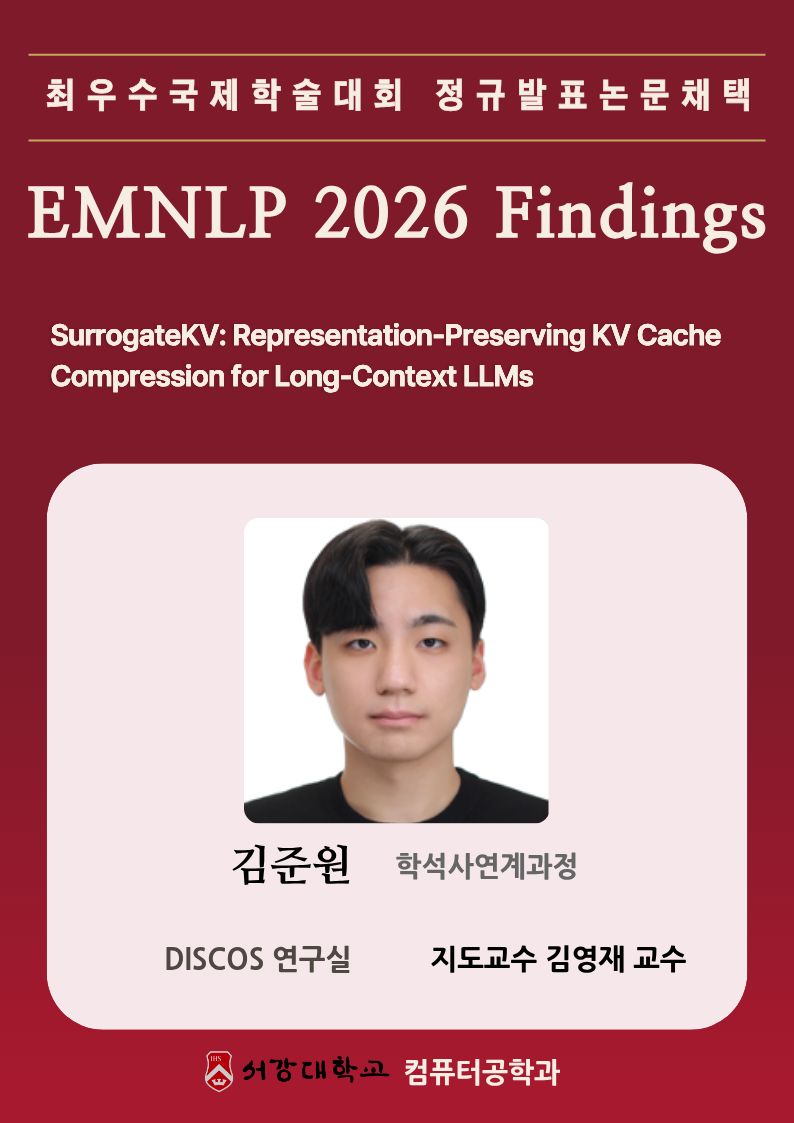
The paper 'SurrogateKV: Representation-Preserving KV Cache Compression for Long-Context LLMs', written by Kim Jun-won (combined bachelor's–master's, first author), Yoo Jung-hyun (doctoral), Farid Talibli (combined master's–doctoral), Professor So Jung-min and Professor Kim Young-jae (corresponding author) of the Data-Centric Computing and AI Systems Laboratory (DISCOS), has been accepted at Findings of the Association for Computational Linguistics (EMNLP) 2026 [overall acceptance rate: 5,252/17,669 = 29.7% (main 15.4% + findings 14.3%)].
Kim Jun-won (Computer Science & Engineering '21; supervisor: Professor Kim Young-jae)
Large language models (LLMs) handling long contexts store the key and value states of input tokens in a KV cache and refer to them repeatedly during generation. The KV cache grows with context length, raising GPU memory use and the cost of transfer between prefill and decode. Existing token-eviction approaches keep only the important KV entries and remove the rest. To make up for this, representation-preserving approaches have recently been proposed that group similar KV states or merge the information of the KV entries to be removed into retained KV entries or a particular pivot.
"On the basis of an analysis showing that contiguous context spans marked for removal exhibit higher key and value coherence than a randomly selected set of tokens, and that removing KV entries changes the attention mass allocated to important context spans, the team proposes SurrogateKV. Rather than merging KV entries by similarity-based grouping or around a particular pivot, SurrogateKV uses the attention of recent tokens to assess context importance and decide how contiguous regions are represented. Within a fixed budget, regions of high importance are kept as the original RAW KV, some contiguous regions of low importance are compressed into a single independently referenceable SURROGATE KV, and the rest are dropped. The generated surrogate KV also consists of ordinary KV pairs, so it can be used with standard attention without any additional training or change to the attention operator, and can be combined with existing KV compression techniques such as SnapKV, DynamicKV and Ada-KV.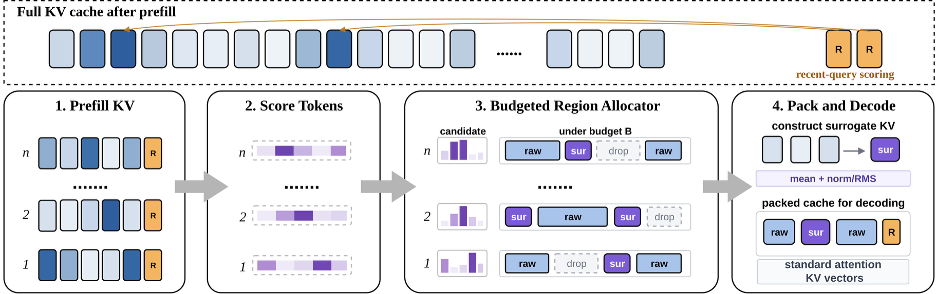
Figure 1. After prefill, SurrogateKV assigns context regions to RAW, SURROGATE or DROP within the given cache budget, and decodes the resulting KV cache with standard attention.
On LongBench, SurrogateKV-Ada combined with Ada-KV scored 41.26 at a budget of 512 slots per layer, higher than Ada-KV's 40.77, retaining 98.4% of performance while using on average only 10.5% of the prefill KV cache compared with FullKV. In comparison with representation-preserving methods such as CaM and D2O, SurrogateKV-Snap scored 37.99 and 40.88 at the corresponding 128 and 512 cache settings, 3.20 and 1.38 points higher on LongBench than the best-performing comparison technique. On NIAH it also improved SnapKV's average retrieval accuracy from 87.51 to 98.84.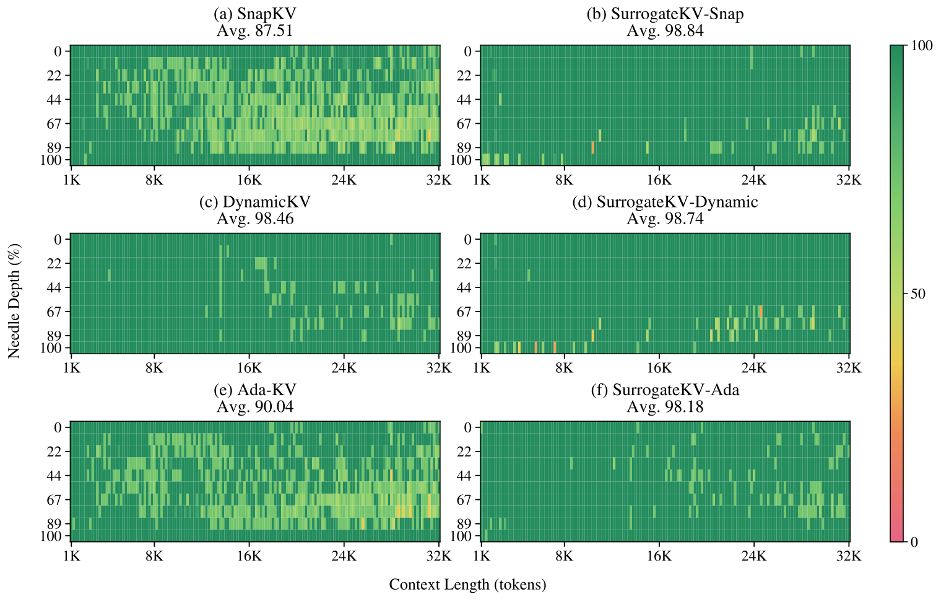
Figure 2. NIAH retrieval accuracy comparing existing compression techniques with SurrogateKV at the same KV slot budget.
The research is significant in extending KV cache compression from simply 'which tokens to keep' to 'in what form to represent the context within a limited cache space'. It shows that, at the same cache budget as existing compression techniques, preserving part of the information of otherwise discarded context in compressed form can improve long-context understanding and retrieval performance.
Kim Jun-won, the paper's first author, said: "Where existing token-eviction approaches focus on which KV entries to keep, this research also considered in what form the context spans to be deleted should be retained. The experiments confirmed that preserving some context as small surrogate KV entries improves long-context performance at the same cache budget. I would like to extend this research on efficient context and state representation to areas where long-term context and state management matter, such as agentic AI and VLA. I am grateful to my co-researchers Yoo Jung-hyun (doctoral), Farid Talibli (combined master's–doctoral) and Professor So Jung-min, and to Professor Kim Young-jae for supervising the research."
The Conference on Empirical Methods in Natural Language Processing (EMNLP) is a leading international conference in computational linguistics and natural language processing, organized by SIGDAT under the Association for Computational Linguistics (ACL). It is classified as a top conference in the Korean Institute of Information Scientists and Engineers' list of outstanding conferences in the software field, and is listed at a recognized IF of 3 among the outstanding international conferences in computer science under the National Research Foundation of Korea's BK21 programme. EMNLP 2026 will be held in Budapest, Hungary, from 24 to 29 October this year.
References:
The 2026 Conference on Empirical Methods in Natural Language Processing (EMNLP 2026)
Website: https://2026.emnlp.org/
Code and data: https://github.com/kimjunewon/SurrogateKV