

Paper Accepted at the IEEE/RSJ International Conference on Intelligent Robots and Systems (IROS)
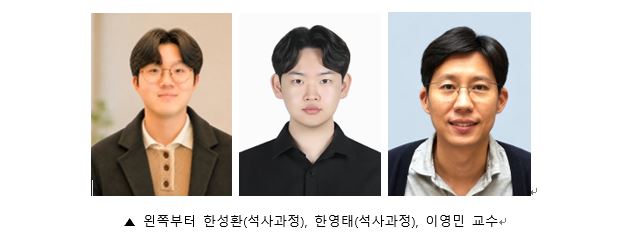
A paper by master's student Han Seong-hwan (first author), master's student Han Young-tae, and Professor Lee Young-min (corresponding author) was accepted at a leading international conference in the field of robotics and automation
Published for acceptance at the IEEE/RSJ International Conference on Intelligent Robots and Systems (IROS).
This paper was presented at IROS 2026, held in Pittsburgh, USA, from September 27 to October 1, 2026.
In this paper, titled "AdaVLA: Adaptive Step Flow Matching for Training-free Acceleration of Vision-Language-Action Models," the researchers demonstrated that, by addressing inference bottlenecks in the Vision Language Action (VLA) model—which generates robot actions through flow matching alongside a large Vision-Language Model (VLM)—it is possible to reduce not only inference time but also energy consumption while minimizing performance degradation by taking model output confidence into account.
Previous image classification research used the model's confidence based on the prediction probabilities of the correct and incorrect classes, but since VLA is inherently generative, existing methods could not be applied. In this study, we focus on VLA-based models learning vector fields that guide a linear path from noise to action, using the curvature of the path that generates actions from noise occurring during the actual inference process as the model's confidence. This enables adaptive inference based on input difficulty, allowing the model to either skip the (1) operation or use fewer channels in the VLM's MLP layer when confidence is high, either by moving directly to the final action state or by doing so.
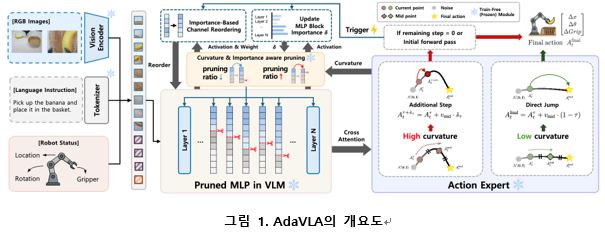
On the edge device Jetson Orin AGX, performing the LIBERO simulation benchmark with the well-known VLA models π0.5 and X-VLA achieved inference time reductions of 1.87 and 2.24 times, respectively, and achieved 1.65 times inference acceleration in benchmarks using real robots while minimizing success rate degradation.
Professor Youngmin Lee stated, "This study is significant in that it proposes curvature as an indicator of confidence for achieving accurate yet efficient adaptive VLA inference and demonstrated its utility in real robots."
References:
IROS: https://2026.ieee-iros.org
High-Performance AI Systems Laboratory: https://aisys.sogang.ac.kr