

Paper Accepted at 'CVPR 2024', a Top Conference in Computer Vision
Files

The research team of Professor Kang Suk-ju, Department of Electronic Engineering,
Paper Accepted at 'CVPR 2024', a Top Conference in Computer Vision
▲ (Top row, from left) Professor Kang Suk-ju, Department of Electronic Engineering; Yang Chang-hee, master's student
(Bottom row, from left) Kang Chan-hee, master's student, Department of Artificial Intelligence (DHE); Oh Ha-ni, master's student; Professor Kong Kyeong-bo, Pusan National University (a Sogang graduate)
A paper presented jointly by the research team of Professor Kang Suk-ju of the Department of Electronic Engineering (master's student Yang Chang-hee of Electronic Engineering, and master's students Kang Chan-hee and Oh Ha-ni of the Department of Artificial Intelligence (DHE)) and the team of Professor Kong Kyeong-bo of Pusan National University has been finally accepted at CVPR 2024, a top conference in computer vision.
CVPR (the Computer Vision and Pattern Recognition Conference), organized by IEEE/CVF, is the most prestigious conference in computer vision and AI pattern recognition. CVPR 2024 will be held at the Seattle Convention Center from 19 to 21 June.
The paper, titled 'Person in Place: Generating Associative Skeleton-Guidance Maps for Human-Object Interaction Image Editing', is the first to propose a framework that automatically generates a human skeleton suited to the input image and then edits the image on the basis of that skeleton and the input text.
In the proposed method, the user selects the region of the input background image containing an object and the region where they want a person to be generated, and the system generates the skeleton of a person interacting with the object in the background. The paper presents a technique for editing the image using an inpainting model with the generated skeleton. Beyond this methodology, the paper also proposes a new model used in generating human poses, called associative attention. It works by propagating weights to the joints, taking into account both the object features and the human features, when generating a person interacting with an object.

▲ The framework architecture proposed in the paper — a skeleton is generated and the image is edited on that basis
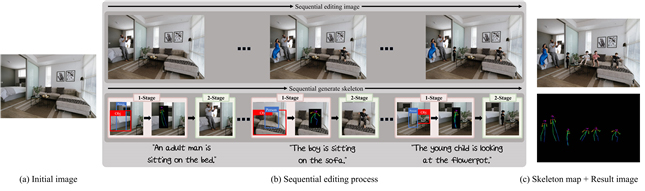
▲ The process of applying the paper's methodology — taking a background image as input and sequentially generating a person interacting with the object
Oh Ha-ni, a master's student who took part in the research, said: "Professor Kang Suk-ju guided us thoughtfully and our seniors in the laboratory gave generous help, which is how we were able to achieve a good result. I am delighted to have had a CVPR publication confirmed in my first semester of graduate school, and I hope many more students in our laboratory will go on to have papers published at international conferences."
Source: Sogang People https://www.sogang.ac.kr/research/res_01.html