

Interview with Students of the Department of Artificial Intelligence, Sogang University (May 2026)
Files


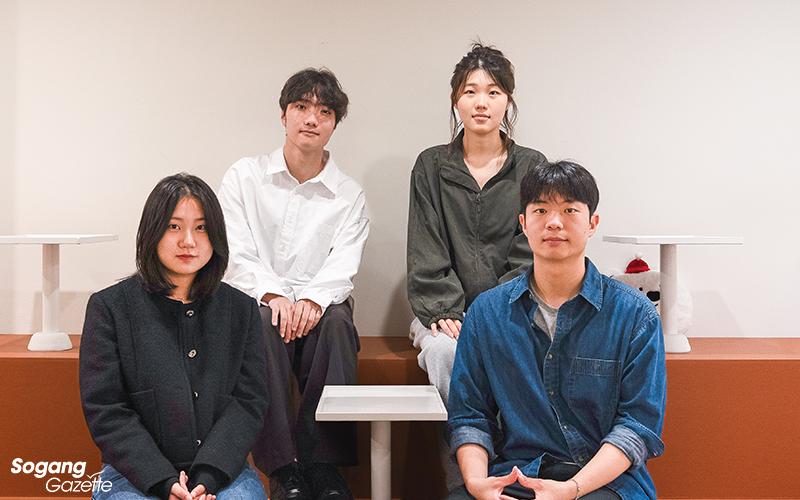
▲ (From left) Song Ji-a (AI '23), Lee Seung-gyu (AI '26), Yoo In-gyo (AI '25),
Jung Hyun-woo (AI '24)
Q. Hello. Please introduce yourselves to Sogang Gadget readers.
Song Ji-a (AI '23): I am Song Ji-a of Sogang University's Department of Artificial Intelligence. I entered as part of the department's first intake and have taken part in a range of activities; at the moment I am focusing on Capstone Design and a generative AI project.
Jung Hyun-woo (AI '24): Hello. I am Jung Hyun-woo, a third-year student in the Department of Artificial Intelligence. I am currently taking 'Generative AI Technology and Applications', where I am learning the operating principles and core theory of various AI models. That led me to take a strong interest in LLMs, and I am now running a research project on 'CoT synthetic data filtering techniques' to improve LLM performance and address the shortage of data.
Yoo In-gyo (AI '25): I am Yoo In-gyo, class of '25, and president of the Department of Artificial Intelligence student council. My main area of interest is LLMs, and recently I have been studying UI and UX while preparing for a competition.
Lee Seung-gyu (AI '26): Hello. I am Lee Seung-gyu, class of '26, and I entered this year. As a first-year student, I am currently putting my energy into building the foundations of my major courses.
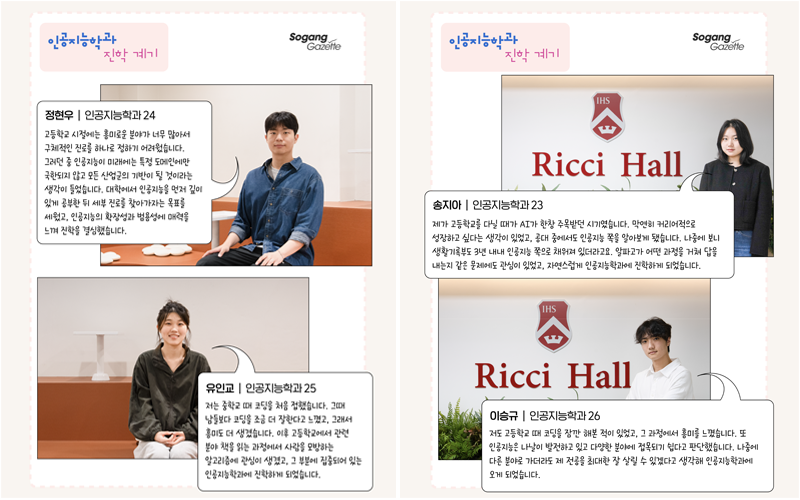
▲ What led the students to the Department of Artificial Intelligence
Q. What is the atmosphere like in Sogang University's Department of Artificial Intelligence?
Song Ji-a (AI '23): With around 30 students per cohort, those who want to take part in departmental activities naturally do so, while others spend their time freely in whatever way suits them. Those who take part in departmental activities become close quickly, and study groups and projects tend to follow naturally. The atmosphere is really good.
Jung Hyun-woo (AI '24): Because it is a small, select department, the atmosphere is very different from that of larger departments. When I entered there was only one cohort above us, and those seniors looked after us with great care. The department's practical laboratory in F401 has also created a bond not only among classmates but between seniors and juniors. Studying and doing assignments together in the laboratory and asking one another questions helped us grow close more quickly.
Lee Seung-gyu (AI '26): My first impression of our department was a family-like atmosphere. Seeing how close and warm the seniors, classmates and juniors are with one another, I really felt it was a department like a single family.
Q. What differences were there between the Department of Artificial Intelligence you imagined before entering and actual life in the department?
Jung Hyun-woo (AI '24): The biggest difference was that the department demands a far deeper level of mathematical ability than I expected. Before entering, I vaguely assumed we would mainly learn programming skills and how to build services. In practice, however, the curriculum focuses on going beyond writing code to build the theoretical foundation for understanding a model's structure completely and taking it a step further.
Lee Seung-gyu (AI '26): I too thought before entering that the Department of Artificial Intelligence mainly involved a lot of coding-related study. But once I actually enrolled and talked with the seniors, I learned that we study a range of subjects such as design, theory and algorithms.
Q. Is there a lecture or project among those you have taken so far that stands out most?
Song Ji-a (AI '23): The 'Artificial Intelligence Experiments' course I took in the second semester of my second year stands out most. In the first and second years we learned the basics of coding, data structures and algorithms; in that course I felt for the first time that I was taking a class truly befitting the Department of Artificial Intelligence. We ran projects in which we brought in data, trained models and produced results. We did web crawling, an assignment visualizing word frequencies, and finally built a project that addressed the difficulties in matching volunteers with volunteering organizations.
Jung Hyun-woo (AI '24): 'Generative AI Technology and Applications', which I am taking now, stands out most. Where the first and second years focused on building overall foundations, this course lets you understand LLMs — the central paradigm in AI today — in technical depth. The final project is particularly special: rather than solving a set problem, we identify our own research topics and develop them to the level of a technical report or paper.
Yoo In-gyo (AI '25): For me, both the most interesting and the most difficult part was matrices. Matrices are a concept that makes complex dimensional calculations concise, and it was fascinating that problems are solved in a different way from the mathematics of the university entrance exam. But the deeper I dug into them on my own, the harder they were to picture in my head — so it was an area where I felt interest and difficulty at the same time.
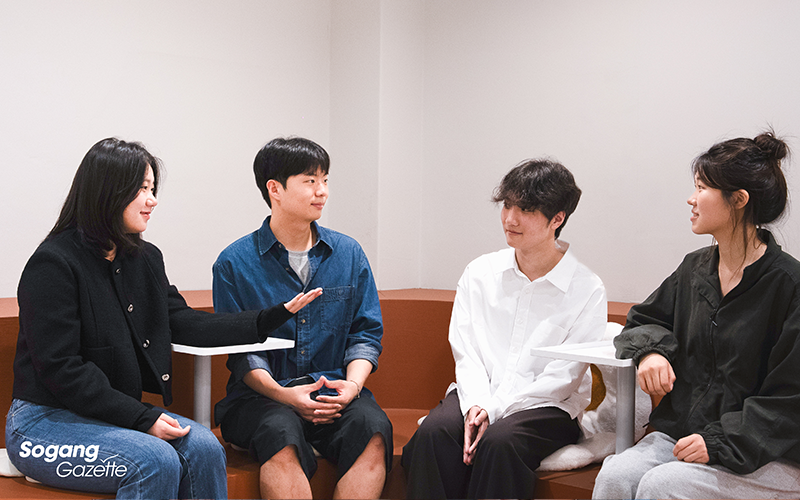
▲ The students of the Department of Artificial Intelligence, met at the campus café 'ing'
Q. What do you find hardest about studying in the Department of Artificial Intelligence?
Song Ji-a (AI '23): Honestly, all of it is hard. You have to learn things you knew nothing about, and when reading papers it is not easy even to follow how the authors arrived at their ideas. I found LSTM difficult when I learned it, and then at some point attention appeared and another new current emerged. So I think you need a process of persevering by continually reading and reviewing new papers.
Jung Hyun-woo (AI '24): Because there are so many sub-fields within the large field of artificial intelligence, the hardest thing was actually deciding which field to move into in future. At first I wanted to dig one well, but I felt there were many areas I had not yet experienced and that I needed more grounding. In meetings with professors I was advised that rather than narrowing my field hastily, it was better first to build solidly the common capabilities that underpin every field — and since then I have tried to study while keeping my options open.
Yoo In-gyo (AI '25): I knew from secondary school that artificial intelligence uses a great deal of mathematics. But coming to university I found that the mathematics I had in mind was not only the probability, statistics and calculus I studied for the entrance exam. I came to appreciate that the broader mathematics behind it is connected to everything from the elementary principles of applying artificial intelligence to its most advanced aspects.
Lee Seung-gyu (AI '26): Using AI in your studies certainly helps. But I am cautious about the fact that it can also become a tool for simply copying. Used well it becomes a tool that supports learning, but used badly you could finish your first year without having learned anything.
Q. What AI field are you most interested in at present, or what field do you think would be interesting combined with AI?
Song Ji-a (AI '23): I find generative AI interesting — the kind that takes text as input and produces not only images but audio and video. I once attended a talk by someone from a games company, and the examples of producing video or audio from text alone made a strong impression. I felt that in fields such as the games industry, where graphics work takes a great deal of time and manpower, AI could greatly change how work is done.
Jung Hyun-woo (AI '24): The field I am concentrating on most at present is LLMs. The AI ecosystem has recently been expanding rapidly around physical AI and on-device AI, but I think the core of the intelligence underpinning them still lies in LLMs. I am paying particular attention to the trend of vertical AI, which combines domain-specific data to drive the autonomy of workflows. I also find it interesting when AI is combined with fields that investigate the principles of the physical world, such as physics or mechanical engineering.
Yoo In-gyo (AI '25): Studying UI and UX recently, I have become interested in ways of collaborating with AI. When I started with UI and UX, I found it hard to create something from nothing. So I have run projects by entrusting the small seed of an idea I have to AI, watching how the AI expands it, and then choosing an interesting direction from within that. For me, AI is less a tool that produces the result on my behalf than a collaborator that expands my ideas.
Lee Seung-gyu (AI '26): I want first to study my major hard and get established to some degree, and then also study humanities and social science fields such as psychology or business administration. I would like to learn them as pure disciplines, and later they could well be combined with my AI major.
Q. What does it mean to study AI at Sogang?
Song Ji-a (AI '23): I think studying AI at Sogang is small and select in the truest sense. The University itself has a small-and-select character, and within it the Department of Artificial Intelligence is a department made up of very few people. That could be a drawback, but I think it also lets us grow more closely together.
Jung Hyun-woo (AI '24): I think studying AI at Sogang is a process of making your own distinctive path. When the AI field meets Sogang's culture of double majors, a great variety of paths can open up according to individual interests — economics and AI, mathematics and AI, and so on. I think Sogang's Department of Artificial Intelligence offers countless paths that you can build according to your own interests.
Lee Seung-gyu (AI '26): I think it means riding the currents of a rapidly changing world. A great deal can change in this field within just a few months, and studying together and exchanging ideas in the same space means you can keep up with those currents without missing them.
Q. Is there anything you would like to see strengthened for the Department of Artificial Intelligence to develop further?
Song Ji-a (AI '23): I would like to see more courses in which we read papers. The AI field changes so quickly that one semester differs from the next. I would like many more courses in which students read and discuss the latest papers so that they can keep up with the trends. At the same time, I hope the parts of the curriculum where the same concepts are repeated several times can be tidied up a little, and lead on to more advanced material afterwards.
Jung Hyun-woo (AI '24): I would like more third- and fourth-year courses that let us experience a wider range of fields. Graduate-linked courses are listed in the departmental course descriptions, but not many of them are actually offered. Also, because many students in the Department of Artificial Intelligence aim to go on to graduate school, I would like more opportunities to build academic experience, such as laboratory experience or writing a CV.
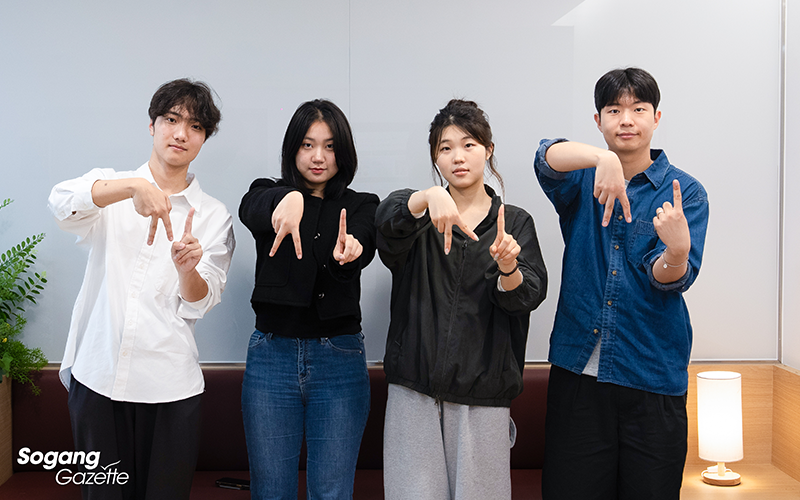
▲ (From left) Lee Seung-gyu (AI '26), Song Ji-a (AI '23), Yoo In-gyo (AI '25),
Jung Hyun-woo (AI '24)
Q. A word, please, for prospective Sogang students considering the Department of Artificial Intelligence.
Song Ji-a (AI '23): If you like mathematics and coding, the Department of Artificial Intelligence may suit you well. That said, you do not need to arrive with all the knowledge from the start. You can come and learn and study. Because study at university differs from study at secondary school, rather than being too intimidated I think it is good to come and take it on directly.
Jung Hyun-woo (AI '24): I hope you will not be afraid because it is a new department or because AI looks too difficult. I recommend coming and experiencing it for yourself. There are countless paths here, and one of them will surely be yours. I was afraid at first too, but now I can say it was a decision I do not regret and a valuable experience.
Yoo In-gyo (AI '25): This is something I would say to the class of '26 as well: I recommend listing concretely the things you want to do before you graduate. Writing down not only academic plans — fields you want to study, exchange study, track choices — but also personal goals such as countries you want to visit or money you want to save makes it much clearer what you want to do at university.
Lee Seung-gyu (AI '26): What I have felt as a first-year is that you do not have to try to solve everything alone. The seniors and classmates help a great deal, and there is an atmosphere in which you can learn by asking questions. I hope you will build your major steadily first and find your own direction within it.
In the fast-changing world of AI, the right answer soon changes. But the attitude of building foundations, learning alongside peers, and seeking to connect one's own interests with other fields endures. From a fourth-year student who has watched the department take shape from close quarters as part of an early cohort, to a first-year now just finishing a first semester, the four students' accounts differed — but they shared one thing: an attitude of keeping up with a fast-changing field without losing hold of the fundamentals. Studying AI at Sogang is perhaps not a matter of being swept along by the speed of change, but a process of finding one's own direction within that current.
Words | Hwang Ji-min (student reporter, European Cultures '24) paisaje@sogang.ac.kr
Photographs | Provided by the Development and Public Relations Team