

Paper Selected as a Best of CAL 2018 Paper by IEEE Computer Architecture Letters (CAL)
Files

A paper submitted to IEEE Computer Architecture Letters (CAL) by graduate students of the Department of Computer Science & Engineering — Min Dong-hyun (first author, supervisor: Professor Kim Young-jae), Ahn Jin-woo (master's student, supervisor and corresponding author: Professor Kim Young-jae) and Park Dong-gyu (master's student, supervisor: Professor Park Sung-yong) — has been selected as a Best of CAL 2018 paper.
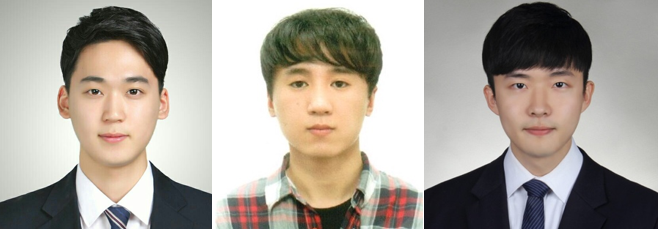
▲ From left: Min Dong-hyun (first author, supervisor: Professor Kim Young-jae), Park Dong-gyu (master's student, supervisor: Professor Park Sung-yong), Ahn Jin-woo (master's student, supervisor and corresponding author: Professor Kim Young-jae)
Three papers in total were selected as Best of CAL this year, and the selected papers will be presented by invitation in the Best of CAL special session at HPCA 2019: The 25th International Symposium on High-Performance Computer Architecture, held in Washington, DC, in February 2019.
IEEE Computer Architecture Letters is a distinguished international journal with an acceptance rate of around 24%, making it highly competitive. HPCA, moreover, is the world's foremost conference in computer architecture.
The paper is titled 'Amoeba: An Autonomous Backup and Recovery SSD for Ransomware Defense'. It proposes a solid state drive (SSD) system capable of automatic ransomware detection, backup and recovery to defend against ransomware data tampering attacks, using logistic classification-based machine learning. In particular, the technology developed in this research is implemented as firmware software inside the device, enabling the device to detect malware attacks and back up and recover data by itself without host assistance. To demonstrate the merits of the work, real ransomware applications were run in a Linux environment and block-layer I/O traces including data content were collected. Classification learning was performed on the collected trace data, and on that basis the SSD detects ransomware attacks in incoming data. Simulation of the SSD's internal operation demonstrated that high-speed ransomware detection and selective backup page creation and management are indeed possible.
The research was conducted as an international collaboration with the University of Texas at San Antonio (co-authors: Ryan Walker and Professor Lee Joong-hee).