

[DAUM jobsN Article] Park Ji-soo, CEO of SOOHO, a Blockchain Security Company, and a Graduate of Sogang University's Department of Computer Science & Engineering (Class of '11)
Files

I am the Korean whom that famous billionaire nudged in the side
The identity of the Korean in his twenties whom a Hong Kong billionaire nudged and said "let's work together"
Park Ji-soo, CEO of SOOHO
A blockchain security company
Winner of the Best Technology Award at the Binance hackathon
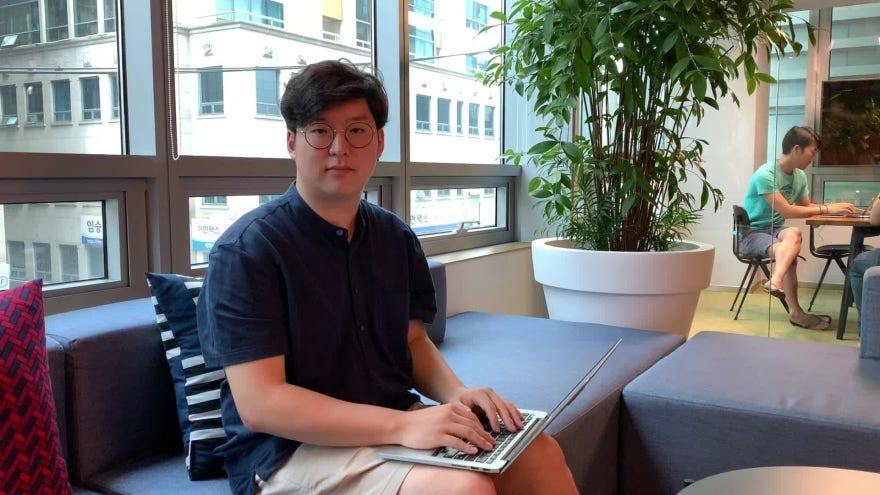
"Let's be sure to work together some time."
On 20 January in Singapore, someone nudged Park Ji-soo (29), CEO of SOOHO, in the side and made that proposal: Changpeng Zhao, founder of Binance. Binance is Asia's largest cryptocurrency exchange. Changpeng Zhao rose to the ranks of billionaires through blockchain and was ranked third among the 'cryptocurrency rich' selected by Forbes last year. He is known to hold cryptocurrency worth between 1.1 and 2 billion dollars (1.1924–2.168 trillion won as of 19 January).
At the time, Park Ji-soo was attending the 'Binance SAFU Blockchain Hackathon' as part of the Korean team. A hackathon is a portmanteau of 'hacking' and 'marathon' — a kind of competition in which planners, developers and designers take part to build a service on a given theme within a set time. The Binance SAFU Blockchain Hackathon brought together 20 teams representing countries around the world. There were more than 100 professional developers alone, from the United States, the Netherlands, Hong Kong, Berlin and elsewhere, including a development team from LinkedIn, a well-known Silicon Valley company. The hackathon theme was 'how to prevent money linked to cybercrime from entering cryptocurrency exchanges'. SOOHO, a blockchain security company, received the Best Technology Award there.
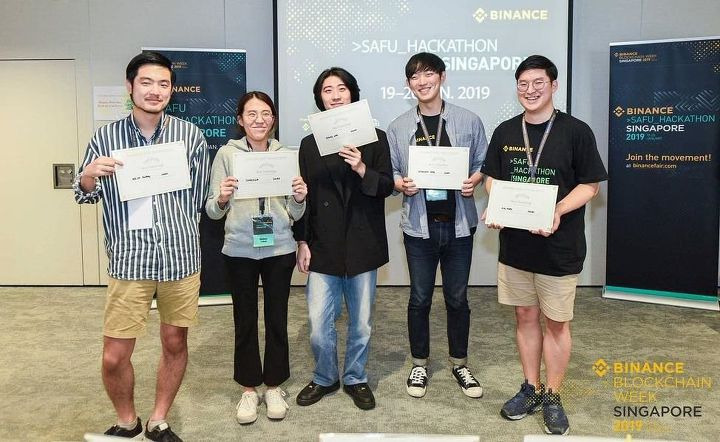
SOOHO, the blockchain security solutions company that won the Best Technology Award at the Binance hackathon. Standing at far right is SOOHO founder and CEO Park Ji-soo.
◇ As a university student he also developed 'Nun-tteumyeon Sinchon', an integrated bus platform
SOOHO's approach to the problem was data. Using data collected during blockchain transactions, SOOHO separately stores patterns of malicious accounts and suspicious or high-value transactions — the so-called 'bad actors'. SOOHO built a program that automatically reports to platform operators when it detects movement by such actors on a cryptocurrency exchange. It is similar to a hospital system that automatically alerts a doctor when a thermometer monitoring a patient's temperature in real time shows an abnormality. SOOHO has collected and analysed more than 1.5 million cases of such anomalies using its own technology.
Park Ji-soo had already started a business as a university student. Having majored in computer science and engineering at Sogang University, he developed an integrated bus platform system with a junior in 2014. 'Nun-tteumyeon Sinchon' was a service conceived by Park Ju-hyuk, Park Ji-soo's junior, to relieve students' commuting difficulties. It targeted students living in Incheon, Suwon and Bundang who fell into commuting blind spots. Applications were taken and shuttle buses were run on efficient routes. Like a corporate commuter bus, only students who applied online could board. 'Nun-tteumyeon Sinchon' met with an enthusiastic response, and demand from students wanting additional routes led the service to expand to universities across Seoul.

Park Ju-hyuk, co-CEO of 'Nun-tteumyeon Dochak', appearing on the talk programme Sebasi to describe founding the shuttle bus platform. Park Ji-soo had entrepreneurial experience with colleagues from his university days.
"At 'Nun-tteumyeon Sinchon' I built the attendance system and the databases. The response was so good that the service passed break-even within a few months of launch. We expanded beyond the Sinchon area to a Korea University route as well; the bus service to Korea University was called 'Nun-tteumyeon Dochak'. Efficient route operation cut a 90-minute commute to an hour. Then one day a warning letter arrived from a transport company, saying our service was illegal and would not be tolerated. We were a start-up that had registered as a business and was operating by the proper procedures. The bus company's logic was that bus routes are themselves company assets and that we had infringed them. In the end we had no choice but to close the business."
Legally speaking, a transport licence counts as a patent-type authorization under administrative law. When a new operator enters the market, incumbents can demand that they stay out on the grounds of that authorization. After his student start-up experience, Park Ji-soo worked as a developer intern at Dunamu before graduating. Dunamu is a blockchain company that operates the cryptocurrency exchange Upbit and Kakao Stock, among others. He was offered a permanent position and worked there for two years and six months. "At first I meant only to complete the internship. But as I worked, I liked Dunamu's stated business value of 'resolving information asymmetry', so I stayed a long time. That experience let me see that a variety of software inconveniences could be resolved with blockchain."
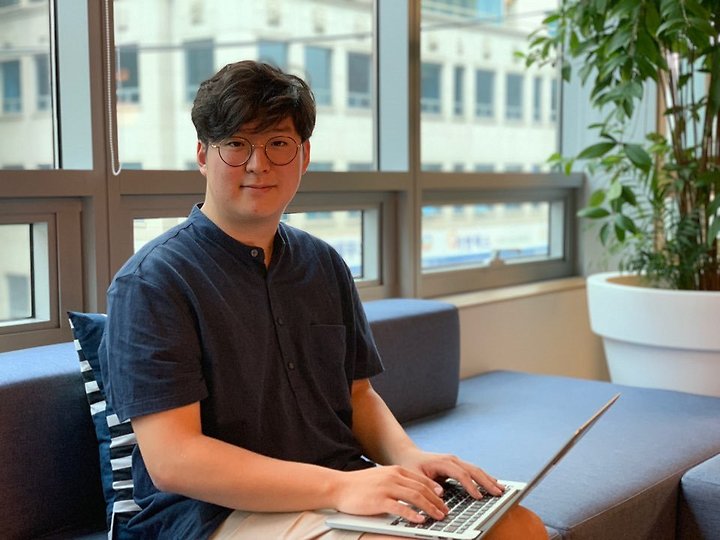
Park Ji-soo, CEO of SOOHO.
◇ The software built for a competition became the start-up's product
SOOHO, the blockchain security company, was founded by Park Ji-soo after he entered the graduate programme in computer science at Korea University. While working at Dunamu, his interest in security grew, as he saw it as a field where technology could add value to the world. He went to see a senior working as a professional white-hat hacker (a hacker who protects information, unlike hackers who steal it). The senior recommended a book, 'An Introduction to Hacking for Aspiring White-Hat Hackers'. Park Ji-soo then met Professor Lee Hee-jo of Korea University's Department of Computer Science, who had written a review of the book.
He said, "I have never done security work and don't know how to study it." Professor Lee Hee-jo replied, "Try applying to graduate school." In 2016 he entered the combined master's–doctoral programme in the Department of Computer Science at Korea University. While studying at graduate school he worked part time at Dunamu. In 2017 he entered the National University Student Software Challenge and won the Top Excellence Award. The software he developed there enabled him to found SOOHO. He built a risk detection solution called 'Bulldozer' for the competition. Bulldozer is a bot that analyses vulnerabilities as the developer writes code. "Most developers do not consider the security of the software they are building at the initial programming stage, because they think of verifying security as a final step after release. Software security work is also handled separately by dedicated security staff, so it is inevitably seen as separate from development. But that creates a great deal of inefficiency."
"Take construction as an example. If a door doesn't fit its frame or a leak appears after the house is finished, many places have to be repaired. Only if there is someone inspecting carefully from the start of construction to prevent errors can accidents be minimized. Program development is the same. If there is an automated bot that alerts programmers in real time when they enter code vulnerable to attack, they can write software of far higher quality. We developed this software and won the Top Excellence Award at the competition. Afterwards, on our supervisors' suggestion that we start a business with the 'Bulldozer' service, we completed business registration in August 2018."
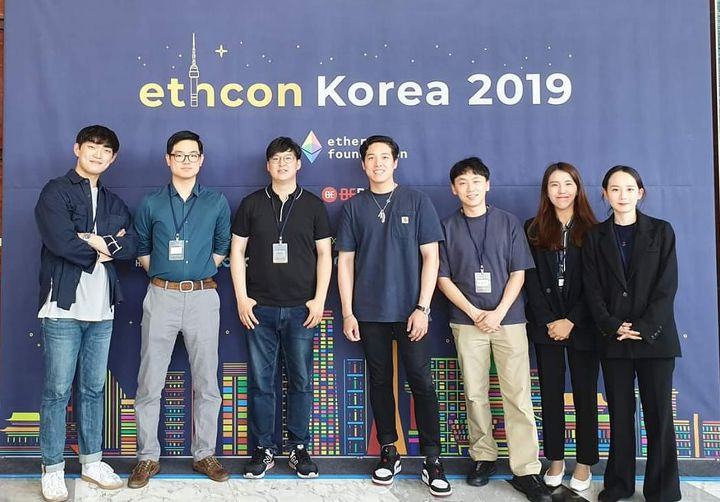
SOOHO staff attending EDCON, a conference hosted by the Ethereum developer community.
◇ "I hope the value of personal data and security is treated as more important"
SOOHO has added a second service to its founding model and now provides security solutions on two tracks. One is 'Odin', an automated program with which developers can quickly identify vulnerabilities in their code at any time. The other is an anti-money laundering service for cryptocurrency called 'Heimdall'. Heimdall is a system that quickly alerts operators and enables action when reports of suspicious malicious accounts or dubious high-value transactions appear during blockchain transactions, identifying malicious accounts and suspect high-value transactions on the basis of SOOHO's data. If 'Odin' is the initial design system for building a sound house, 'Heimdall' plays the role of a guard who checks the identity of those coming and going from the finished house so that problems do not arise.
Early this year SOOHO won the Top Excellence Award at the Binance hackathon preliminary round held at D.CAMP and took part in the Binance global hackathon as Korea's representative. It then drew attention by winning the Best Technology Award at the world final of the Binance hackathon — to the point that Binance founder Changpeng Zhao proposed working together. In May it received investment from ConsenSys, the investment company founded by Ethereum co-founder Joseph Lubin. SOOHO currently has 11 members. Professors Lee Hee-jo and Oh Hak-joo of Korea University's Department of Software Security are co-CEOs.
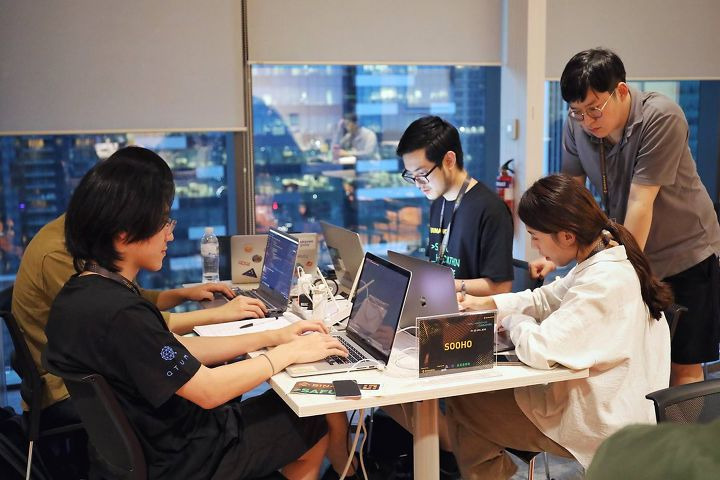
SOOHO staff absorbed in development.
Source: Provided by SOOHO
"I am often asked what I think about the argument that blockchain and cryptocurrency should be regulated. I think the market needs regulation. On 27 July, SOOHO published a 'money laundering report' containing the results of analysing 1.5 million blockchain data points. Transactions using the cryptocurrency Ethereum that make fund flows hard to trace amount to 31 trillion won alone. Of that, about 20 trillion won was used to launder criminal proceeds. Multi-level marketing and Ponzi schemes are being carried out through cryptocurrency."
A Ponzi scheme recruits investors by deceiving them into believing they will make large sums by investing, when in fact no money is being made. The fraudster spends the invested money freely and pays out some of it to earlier investors to make it appear that money is being earned. It inevitably comes to light, and many people suffer losses. "For blockchain and cryptocurrency to establish themselves as a legitimate system, we must be able to block and punish crime. I plan to make SOOHO a company responsible for safe blockchain transactions. Our revenue target this year is 500 million won. We are not yet making large profits, but I am confident that global companies will seek out SOOHO's data."
Words: jobsN, Kim Ji-a
jobarajob@naver.com
jobsN
Go to the article >> https://1boon.daum.net/jobsN/5d6201113fc43135364991ca