

Paper Accepted at ACM HotStorage '21
Files


|
|
|
|
A paper titled 'Isolating Namespace and Performance in Key-Value SSDs for Multi-tenant Environments', written by graduate student Min Dong-hyun of the Department of Computer Science & Engineering (doctoral, 4th semester; supervisor: Professor Kim Young-jae), has been accepted for publication at the ACM Workshop on Hot Topics in Storage and File Systems (HotStorage '21).
ACM HotStorage is a distinguished international academic workshop for cutting-edge storage research, which reviews submissions for originality, technical merit and the likelihood of leading to insightful discussion that will influence future storage system design and applications. This year HotStorage had an acceptance rate of 37.5%. The workshop will be held online from 27 to 28 July this year.
HotStorage site: https://www.hotstorage.org/2021/
Download the paper: https://lass.sogang.ac.kr/pdf/2021/intl_conf/HotStorage_2021_D_Min.pdf
The research proposes Iso-KVSSD, which applies system isolation techniques from both a namespace and a performance perspective to existing state-of-the-art log-structured merge-tree (LSM-tree) based key-value SSDs in cloud environments. Unlike existing key-value SSDs, the proposed Iso-KVSSD enables namespace-based per-user data access control and improved data read performance by more than about 2.9 times in multi-tenant environments.
Figure 1 illustrates the log-structured merge-tree (LSM-tree) managed independently for each namespace. Access to each user's data can be controlled on the basis of the namespace information stored within the LSM-tree. Moreover, unlike approaches in which multiple users' data is indexed together in a single shared LSM-tree, managing each user's data separately by namespace prevents the tree structure from growing deep, greatly reducing LSM-tree lookup latency.
Figure 2 shows the results of evaluating the read performance of Iso-KVSSD, whose design manages an LSM-tree separately per namespace. Unlike approaches in which tenants share a single LSM-tree, Iso-KVSSD minimizes the read performance degradation that arises in multi-tenant environments. The proposed technique minimizes performance loss all the more as the number of concurrently operating tenants increases.
*This research was carried out with the support of SK hynix.
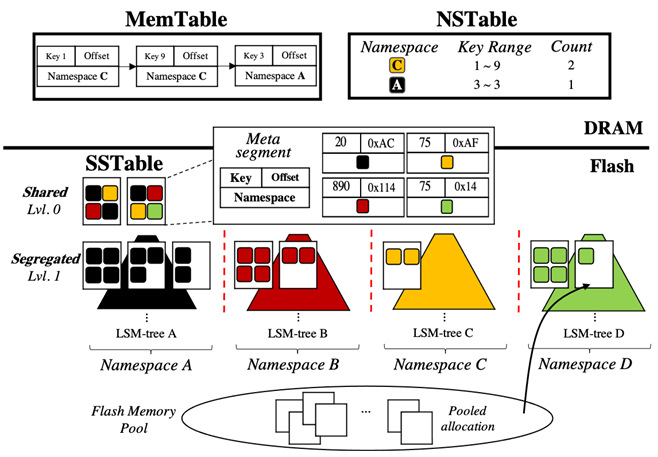
Figure 1. Per-namespace dedicated LSM-tree in Iso-KVSSD
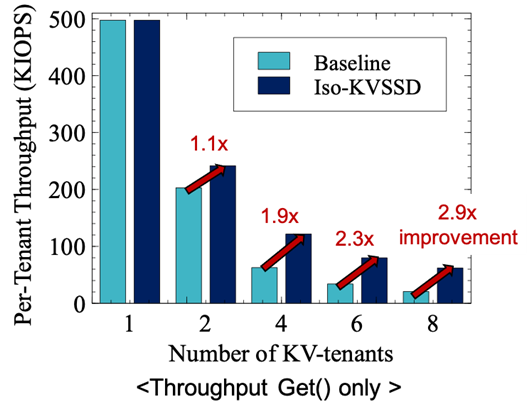
Figure 2. Per-tenant read throughput (KIOPS)