

Professors Kim Young-jae and Park Sung-yong Selected for a National Research Foundation of Korea Mid-Career Researcher Support Project, 2021–2025
Files

Professor Kim Young-jae, Professor Park Sung-yong
Selected for a National Research Foundation of Korea Mid-Career Researcher Support Project, 2021–2025

Professor Kim Young-jae (principal investigator), Professor Park Sung-yong (co-investigator)
The research project 'Hardware/Software Co-Design for ZNS SSD-Based Key-Value Stores', led by Professor Kim Young-jae (principal investigator) with Professor Park Sung-yong (co-investigator) of the Department of Computer Science & Engineering, was finally selected for the National Research Foundation of Korea's Mid-Career Researcher Support programme in the first half of 2021, and will receive 800,000,000 won over four years from March 2021 to February 2025.
The National Research Foundation of Korea selects and supports mid-career researcher projects each year in order to strengthen the academic capabilities of outstanding researchers and enable long-term creative research.
Professors Kim Young-jae and Park Sung-yong have previously received support from the Institute of Information & Communications Technology Planning & Evaluation (IITP) for foundational research on ultra-high-performance scalable manycore-based operating systems (research on developing file systems that provide scalability on manycore systems). With this mid-career selection they will be able to continue their research on redesigning and optimizing the I/O stack of key-value stores based on ZNS (Zoned Namespace) SSDs.
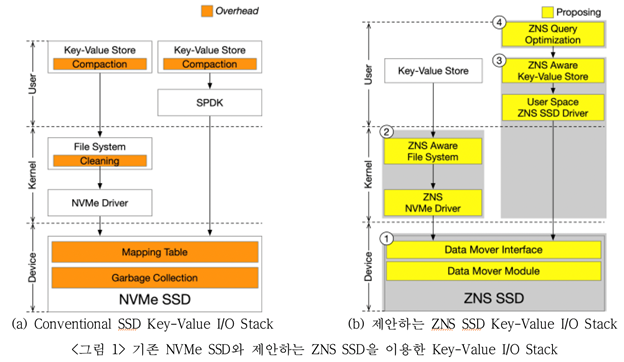
Summary of the research project: With artificial intelligence and machine learning technologies drawing attention recently, demand is growing for high-performance big data processing technologies that use large-scale data. Big data processing technologies, which must provide both large capacity and high performance, are being developed using key-value interfaces applicable to various data formats on the basis of NVMe SSDs. However, current key-value I/O stacks suffer from write amplification because of overlapping functions such as compaction in the key-value store (KVS), cleaning in the file system (FS) and garbage collection (GC) inside the SSD. As a solution to this write amplification problem, Zoned Namespace (ZNS) SSDs have recently been proposed, which remove GC inside the SSD and use zones permitting only sequential writes.
ZNS SSDs, drawing attention as next-generation SSDs, are expected to reduce write amplification markedly, but their I/O semantics differ from those of existing SSDs, making a redesign of the I/O stack unavoidable. This research therefore includes a ZNS SSD hardware prototype and carries out hardware/software co-design for research on optimizing ZNS SSD-based key-value I/O stacks.
On being selected, Professor Kim said: "With the advance of semiconductor technology, ZNS devices have been released and a redesign of the existing I/O software stack for them is very urgent. I am delighted that the National Research Foundation's support will allow us to carry out research on optimizing existing file systems and unstructured database I/O stacks."