

[Article] The Future of an AI Graduate School, Built Together with Industry
Files


It is clear that AI technology is the foundation on which the greatest high value-added of future society will be generated. Specialized AI research and talent development are therefore essential if a university is to remain competitive. At the proclamation ceremony for 'Sogang VISION 2030', President Shim Jong-hyuk likewise set out the establishment of an AI graduate school as one of Sogang's most important tasks. Sogang University took its first step by concluding industry–academia agreements with Korea's leading IT companies, including Smilegate and LG Electronics. Sogang Gadget followed that journey. |
On 22 June 2021, 'Sogang VISION 2030' — a blueprint for a century of Sogang's future and innovation — was proclaimed in the auditorium of Ignatius Hall. President Shim Jong-hyuk proposed seven medium- to long-term goals for Sogang to achieve in pursuit of becoming a top-three research-oriented university leading research, industry cooperation and entrepreneurship; among them, the establishment of an AI graduate school and an undergraduate advanced AI department stood out.
President Shim announced his ambition to establish AI graduate programmes and advanced departments in future industry fields over the next ten years and to build an AI industry–academia–research cluster. The plan is to lead the future by beginning full-scale research into convergence AI technologies, in addition to Sogang's existing computer science and engineering, electronic engineering and AI interdepartmental major. The establishment of the graduate Department of Artificial Intelligence (March 2022) and the undergraduate Department of Artificial Intelligence (March 2023) was readily approved by the University's Board of Trustees on 14 September.
The University's AI graduate school in particular will further raise its competitiveness on the basis of partnerships with industry, setting it apart from other universities. The graduate Department of Artificial Intelligence, to be established from March next year, will comprise three specializations: AI Convergence, Digital Human & Entertainment (Culture), and Smart AI. Of these, the two other than AI Convergence will be opened on the basis of industry–academia cooperation with Smilegate and LG Electronics respectively. At the memorandum ceremonies in September, the two companies pledged scholarship funding, employment linkage and support for curriculum design. Through this partnership, the companies can identify Sogang's outstanding talent while Sogang can build solid infrastructure.

Smilegate and LG Electronics held signing ceremonies with Sogang University to establish specializations within the graduate Department of Artificial Intelligence. Senior figures from both sides attended the events and spoke with confidence about the vision for each track.
# Sogang Meets Smilegate (Digital Human & Entertainment Specialization)
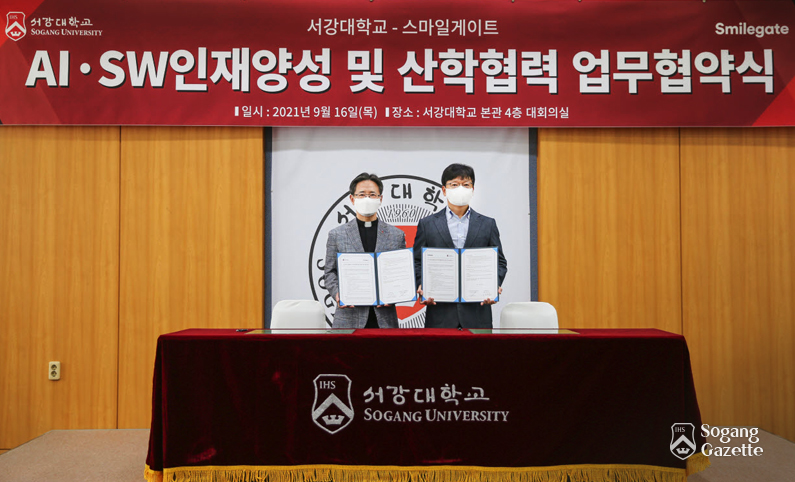
▲ (From left) Shim Jong-hyuk, President of Sogang University; Kwon Hyuk-bin (Electronic Engineering '92), Chairman of Smilegate Hope Studio |
On Thursday 16 September, President Shim Jong-hyuk and Smilegate Chairman Kwon Hyuk-bin greeted one another in the large conference room on the fourth floor of Sogang University's main building. It was the site of a memorandum of understanding between Sogang and Smilegate for 'AI·SW talent development and industry–academia cooperation'.
Smilegate is a global entertainment and content company founded in 2002 by alumnus Kwon Hyuk-bin of the Department of Electronic Engineering, class of '92. With formidable titles such as CrossFire, Tales Runner and Lost Ark to its name, the company ranks among the top five in Korea's games industry and is competitive on the world stage as well as at home.
Drawing on their experience of founding a game start-up at university and growing it through the power of content, Chairman Kwon and his management team have systematically supported young entrepreneurs and their independence. Representative examples include establishing the start-up support system Orange Planet to nurture youth entrepreneurship, and co-sponsoring 30 million won with the developer Awesomepiece to support the independence of young people leaving home. The Art & Technology Centre, established in 2013, is likewise a product of these efforts to cultivate creative talent — all the more reason to look forward to Sogang's young researchers working with Smilegate on artificial intelligence.
That day, Smilegate pledged around 1 billion won in support to Sogang each year and announced that it would build a joint research partnership to cultivate AI talent and lead advanced industry.
Specific plans for future cooperation raised at the ceremony included ▲cultivating AI talent, ▲jointly designing the curriculum for advanced AI departments and supporting SW industry–academia cooperation, ▲research to strengthen medium- to long-term AI research capability and secure core technology, and ▲jointly establishing a Smilegate research centre.
On the basis of this cooperation, a Digital Human & Entertainment specialization will be established in the Department of Artificial Intelligence at Sogang University's AI graduate school. The programme will admit 20 master's students each year through joint interviews conducted by the University and Smilegate, and successful applicants will receive scholarships worth 18 million won per person. Smilegate also plans to contribute to the cultivation of convergence digital talent by jointly designing the curriculum for AI foundation and other major courses and by creating a cloud computing environment for AI·SW practical training.
The efforts to strengthen research capability are also noteworthy. Alongside establishing the graduate specialization, Sogang University and Smilegate will jointly establish the Smilegate Digital Human Research Centre to strengthen medium- to long-term AI research capability and secure core technology. The centre will be staffed by Smilegate researchers together with Sogang faculty and graduate students, who will collaborate on AI industry–academia projects. To this end, Smilegate will provide project research funding and centre operating costs as industry–academia research projects are identified, while the University will provide dedicated research centre space for graduate students.
At the ceremony, President Shim Jong-hyuk said: "Sogang University is attempting a range of changes to realize AI-based convergence education across the humanities and sciences, to build a metaverse framework, and to support entrepreneurship. I express my deep gratitude to Smilegate for lending further strength to these efforts, and we will continue to do our utmost to cultivate the talent that will lead the AI era."
In reply, Kwon Hyuk-bin — a Sogang University alumnus (Electronic Engineering '92) and Chairman of Smilegate Hope Studio — responded: "I am genuinely delighted to be conducting AI research together with my alma mater, Sogang University." He added: "When the internet first appeared, everyone was preoccupied with the network itself, but in the end what mattered was what you did with it. In the same way, rather than AI technology in itself, we will think hard about what new industries and value can be created using AI technology. I hope this occasion becomes the moment when Sogang University overtakes the future."
# Sogang Meets LG Electronics (Smart AI Specialization)
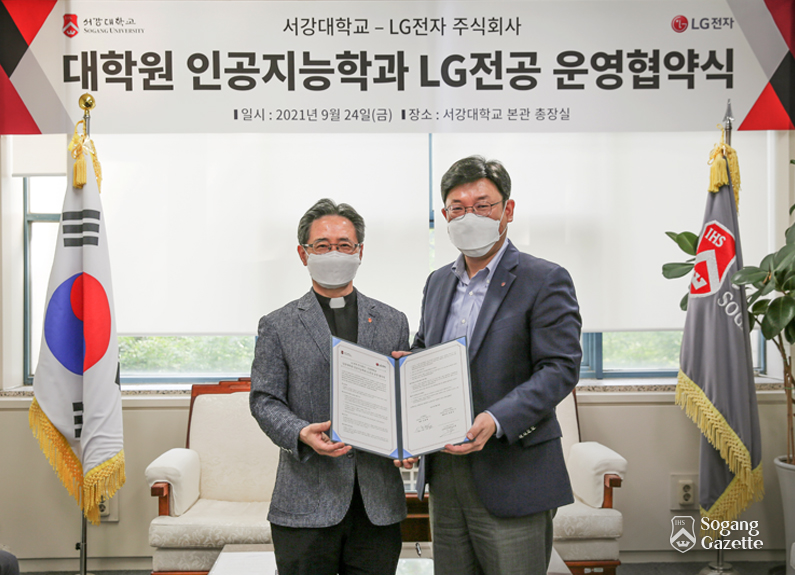
▲ (From left) Shim Jong-hyuk, President of Sogang University; Noh Do-yeop, Executive Director of HR, LG |
On Friday 24 September, Sogang University and LG Electronics signed a memorandum of understanding for the operation of the 'LG Track' in the graduate Department of Artificial Intelligence.
The two sides likewise discussed the composition and operation of the 'Smart AI' track of the AI graduate school, to be established from March 2022, and pledged a range of support for cultivating AI talent and conducting industry–academia research in future growth industries such as ▲artificial intelligence, ▲big data, ▲robotics and ▲automobiles.
The 'Smart AI' track of the AI graduate school admits 18 new master's students each year. In addition to remuneration for work as a teaching assistant (TA) or research assistant (RA), successful applicants receive an industry–academia scholarship of some 18 million won a year (tuition and a study allowance); it is an employment-contract programme in which employment at LG Electronics is guaranteed upon graduation. LG Electronics also designs the AI curriculum jointly with the University and provides vacation internship programmes and operating funds for the specialization. The 'Smart AI' track will be expanded into practice-centred industry-linked programmes covering autonomous driving, mobile robotics, bio/healthcare, Connected AI (communications), smart home appliances and secondary-battery BMS. The aim of the specialization is to cultivate highly capable AI talent that meets LG's needs. To that end, LG Electronics will open courses and deliver lectures on the latest practical technologies itself, and will support internships and field placements during vacations together with the students' supervising professors.
President Shim Jong-hyuk expressed his gratitude for LG Electronics' cooperation, saying: "This agreement will be an important occasion for a university and a company to cooperate in cultivating the talent that will lead the artificial intelligence industry. Through it, we expect to cultivate the finest AI specialists who will prepare and lead future technology in domains such as the smart home, automobiles and public spaces." He added: "We will spare no institutional support so that LG Electronics can secure and select the outstanding personnel it needs, and we will continue to work to develop an ever closer relationship between the two organizations."
Noh Do-yeop, Executive Director of HR, expressed pride, saying: "Many Sogang University alumni are working together at LG Electronics for the company's growth, and as a result LG Electronics now makes world-leading products and is preparing the next stage." He also voiced his expectations: "Taking the newly established 'Smart AI' track under this agreement as a starting point, we hope to continue working with Sogang University's outstanding students, and that network exchange between our two organizations will make research all the more active."

To learn more about the Department of Artificial Intelligence, which begins recruiting in October, we met Professor Nang Jong-ho of the Department of Computer Science & Engineering, head professor of the Department of Artificial Intelligence, and heard the details.

Good to meet you, Professor. What are the distinguishing features and direction of Sogang University's graduate Department of Artificial Intelligence, compared with other universities receiving government support?
The biggest distinguishing feature is a curriculum based on AI project themes centred on experience and problem-solving rather than teaching.
The Department of Artificial Intelligence, opening from March next year, will run three specializations in total: AI Convergence, Digital Human & Entertainment, and Smart AI. All three emphasize agreements with industry and an interdisciplinary programme for AI-X, and the curriculum itself will be designed in the direction industry wants.
Where graduate schools at other universities concentrate on inquiry into AI technology in itself, Sogang University's graduate Department of Artificial Intelligence pairs core AI education with detailed inquiry into how AI technology can be applied within each academic field (AI+X). The scope extends broadly — not only to medical image processing, media information processing and language, but also to management, finance and economics.
To take economics as an example, the focus would be on 'AI finance research' that solves problems in finance that have until now been difficult to address, through the convergence of economics and AI technology. Inquiry into artificial intelligence itself matters, but in the era of the Fourth Industrial Revolution one must consider how to use AI, grounded in one's own field, to solve long-standing problems. In that sense, Sogang University's graduate Department of Artificial Intelligence is an initiative aligned with the goal of cultivating the convergence talent the Fourth Industrial Revolution requires.
Could you briefly introduce the tracks supported by Smilegate and LG?
The Digital Human & Entertainment track supported by Smilegate admits 20 students a year and provides 18 million won annually in tuition and living-expense support. There may be a requirement to complete a vacation field-placement course as a Smilegate intern, but the graduate programme is not directly linked to employment at Smilegate. In line with alumnus Kwon Hyuk-bin's intention to design 'a curriculum based on AI project themes centred on experience and problem-solving rather than teaching' in particular, field project-based courses will be placed throughout the curriculum, and Smilegate practitioners will take part in jointly designing courses in areas such as games and the metaverse.
The Smart AI track supported by LG Electronics is an employment-contract programme in which students spend two years of a master's course as industry–academia scholarship students (18 million won a year, covering tuition and living expenses) and are then guaranteed employment at LG Electronics. The main curriculum covers automobiles, robotics, big data and artificial intelligence — fields aligned with the needs of LG's future growth industries.
Both provide full scholarships as well as living expenses, so students can immerse themselves more fully in study and research. They are also backed by active industry–academia cooperation and computing infrastructure support from Smilegate and LG Electronics, which is another competitive advantage. We will soon hold an admissions briefing explaining the exact curriculum and admission requirements, so we ask for your close attention.
Twenty-eight professors working in AI-related areas across nine departments (computer science and engineering, electronic engineering, art and technology, business administration, economics, mathematics, physics, English literature and others) will take part in the graduate Department of Artificial Intelligence as joint-appointment faculty, and we will continue to appoint full-time faculty dedicated to the department alongside the establishment of the undergraduate Department of Artificial Intelligence.
For coursework, courses will be opened jointly by each graduate department and the Department of Artificial Intelligence, and we will newly establish AI foundation courses for students from other majors along with advanced courses, convergence courses and advanced capstone design courses. A developmental reorganization into an independent department is planned for the future.
I wonder whether there are requirements for admission to Sogang University's graduate Department of Artificial Intelligence, and what kind of students you are recruiting. How should students interpret the change represented by the establishment of the undergraduate and graduate Departments of Artificial Intelligence?
There is no restriction limiting applicants to AI-related majors such as computer science and engineering or electronic engineering. If anything, because students in computer science and engineering or electronic engineering can already study AI in their own graduate departments, this Smilegate specialization will actively recruit not only computing and electronic engineering students but also students from other majors seeking to combine AI technology with their own disciplines.
That said, to keep up with AI coursework, applicants will need knowledge and interest at roughly the level of having completed a software- or AI-related interdepartmental major (such as Convergence Software, Artificial Intelligence, or Big Data Science) or a double major offered at undergraduate level. Current students who have developed an interest in AI but do not know where to begin are encouraged to start by taking the three interdepartmental majors mentioned above and learning the foundational theory.
We look forward to keen interest and bold applications from students who wish to combine AI knowledge with their own major and become competitive specialists.
In March 2022, Sogang University will establish the AI Convergence specialization, the Digital Human & Entertainment (Smilegate) specialization and the Smart AI (LG Electronics) specialization. In line with the graduate admissions schedule, recruitment of new students begins on 6–13 October (first round) and 10–16 November (second round), and an online admissions briefing will introduce the specializations and explain how they will be run.
The advanced AI industry is, without question, at the heart of future technology. Yet technology creates genuine value only when there is comprehensive consideration of how it will be used, not merely internal advancement. For AI research that pursues harmonious development between people and technology, Sogang's distinctive convergence research environment is expected to be the finest of cradles. We await the challenge of the talent who will build the future together with Sogang.

