

[Article] The A to Z of Establishing Sogang's Department of Artificial Intelligence — Can It Be Introduced Successfully?
Files

[Feature] The A to Z of Establishing Sogang's Department of Artificial Intelligence — Can It Be Introduced Successfully?
- The graduate Department of Artificial Intelligence was left disappointed by April's rejection from the government AI Graduate School support programme... The University says it is "working to turn the mood around by concluding industry–academia agreements with major corporations"
- The Department of Artificial Intelligence to be established in 2023 will admit 42 new students; faculty recruitment is under way
- Expectation and concern are mixed over the new department, with questions and answers exchanged at October's Dialogue with the President
At the third Board of Trustees meeting in September, the establishment of a Department of Artificial Intelligence at the University was decided. Accordingly, a graduate Department of Artificial Intelligence will be established in the 2022 academic year, and an undergraduate Department of Artificial Intelligence in the 2023 academic year.
The University appears to be keeping pace with the recent trend of universities establishing and running AI-related departments. Thirty-six universities including Seoul National University have operated AI-related schools and departments since the 2021 academic year, and in the 2022 academic year a total of 49 universities including Yonsei University and Kyung Hee University plan to admit students to AI-related schools and departments.
We looked into the University's plans for the new Department of Artificial Intelligence and what makes Sogang's approach to AI distinctive, along with opinion within the University about the new department.
[The graduate Department of Artificial Intelligence was left disappointed by April's rejection from the government AI Graduate School support programme... The University says it is "working to turn the mood around by concluding industry–academia agreements with major corporations"]
Two of the three specializations in the University's graduate Department of Artificial Intelligence will be established through industry–academia cooperation (with Smilegate and LG Electronics).
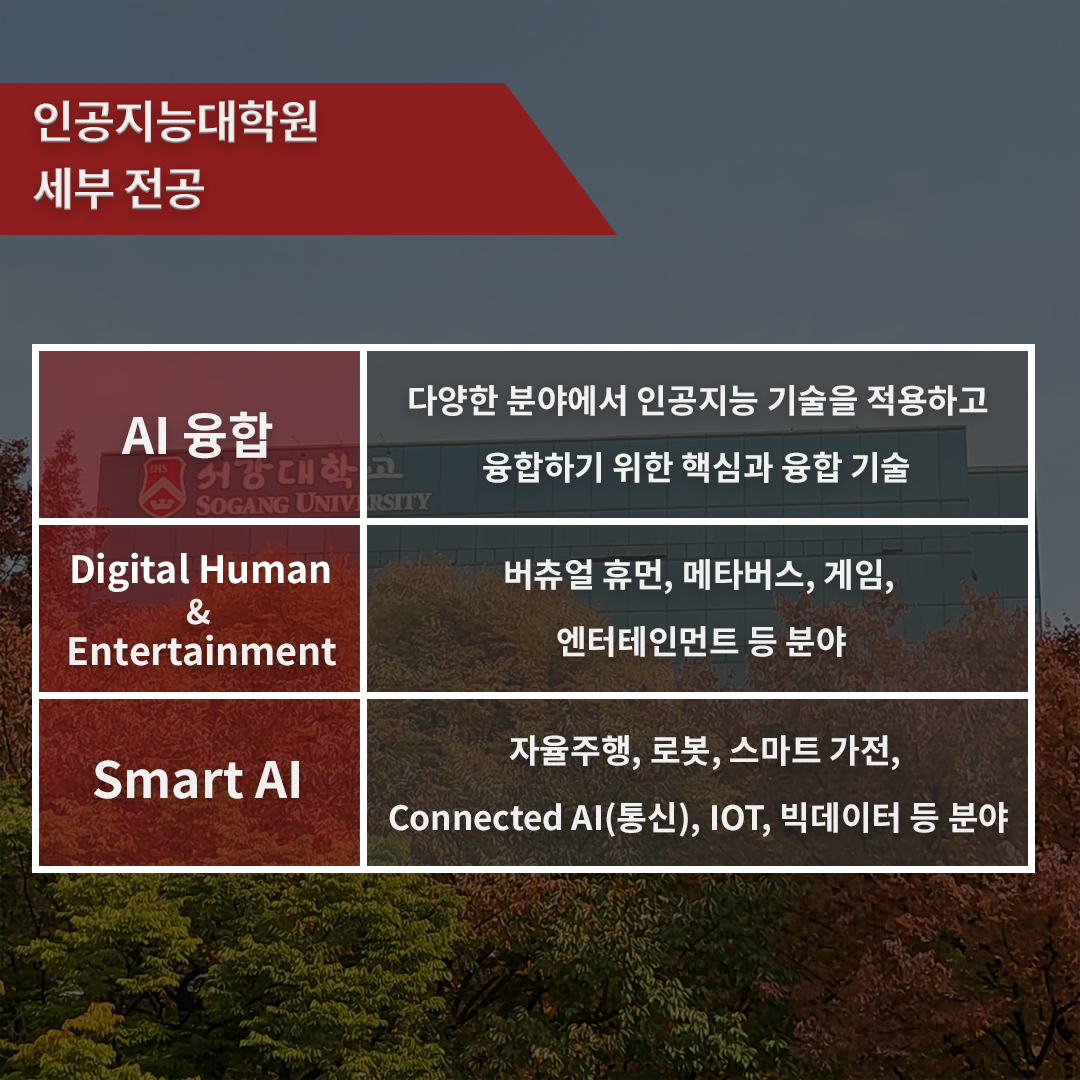
Of these, the Digital Human & Entertainment specialization will be established under the agreement with Smilegate. Twenty of the successful applicants will receive scholarships worth 18 million won a year in addition to research and teaching assistantship stipends. The Smart AI specialization will be established under the agreement with LG Electronics, and 18 successful applicants can receive scholarships of 18 million won a year in addition to research and teaching assistantship stipends.
Admission quotas for each of the three specializations, including AI Convergence, have not been set separately. In an interview with this station, Professor Nang Jong-ho of the Department of Computer Science & Engineering said: "We plan to survey demand on the basis of applicant numbers and admissions data over the first year or two after establishment and then set appropriate quotas," adding that "the quotas can be adjusted flexibly."
Even as the University moves actively to establish the Department of Artificial Intelligence, its final rejection from the AI Graduate School Support Program — under which the Ministry of Science and ICT selects and supports a total of ten universities — remains a disappointment. Under this programme the government provides selected universities with a total of some 19 billion won in financial support over ten years, in order to strengthen future AI competitiveness and drive innovation in the AI industry. The University applied but was not among the two additional universities selected in this final year of the programme (Seoul National University and Chung-Ang University).
Some voiced concern about how the new department will be funded as a result. Asked by this station about the University's funding position and plans for the new department, Professor Nang said: "In our case, under a win-win strategy with our corporate partners (Smilegate and LG Electronics), they have pledged educational programmes and scholarship support on a scale larger than the existing AI graduate school programme budget," adding that "the University will provide the space and budget needed for operations in the early period." Professor Nang also added: "If the Ministry of Science and ICT runs industry-linked AI education programmes in future, this Department of Artificial Intelligence will apply in order to secure funding for scholarships beyond the existing corporate student scholarships and for equipment purchases."
[The Department of Artificial Intelligence to be established in 2023 will admit 42 new students; faculty recruitment is under way]
From the 2023 academic year, the year after next, an undergraduate Department of Artificial Intelligence will be operated. The department will belong to the School of Engineering, with an admission quota of 42 — about half that of the Department of Computer Science & Engineering (101). The 42 will be admitted in addition to existing student numbers, without adjustments such as reducing other departments' quotas.
At the Dialogue with the President held in October, the University said it was "drawing up plans to secure faculty in AI-related fields and working to expand the faculty."
With the establishment of an undergraduate Department of Artificial Intelligence, the routes available at the University for taking AI coursework are expected to increase.
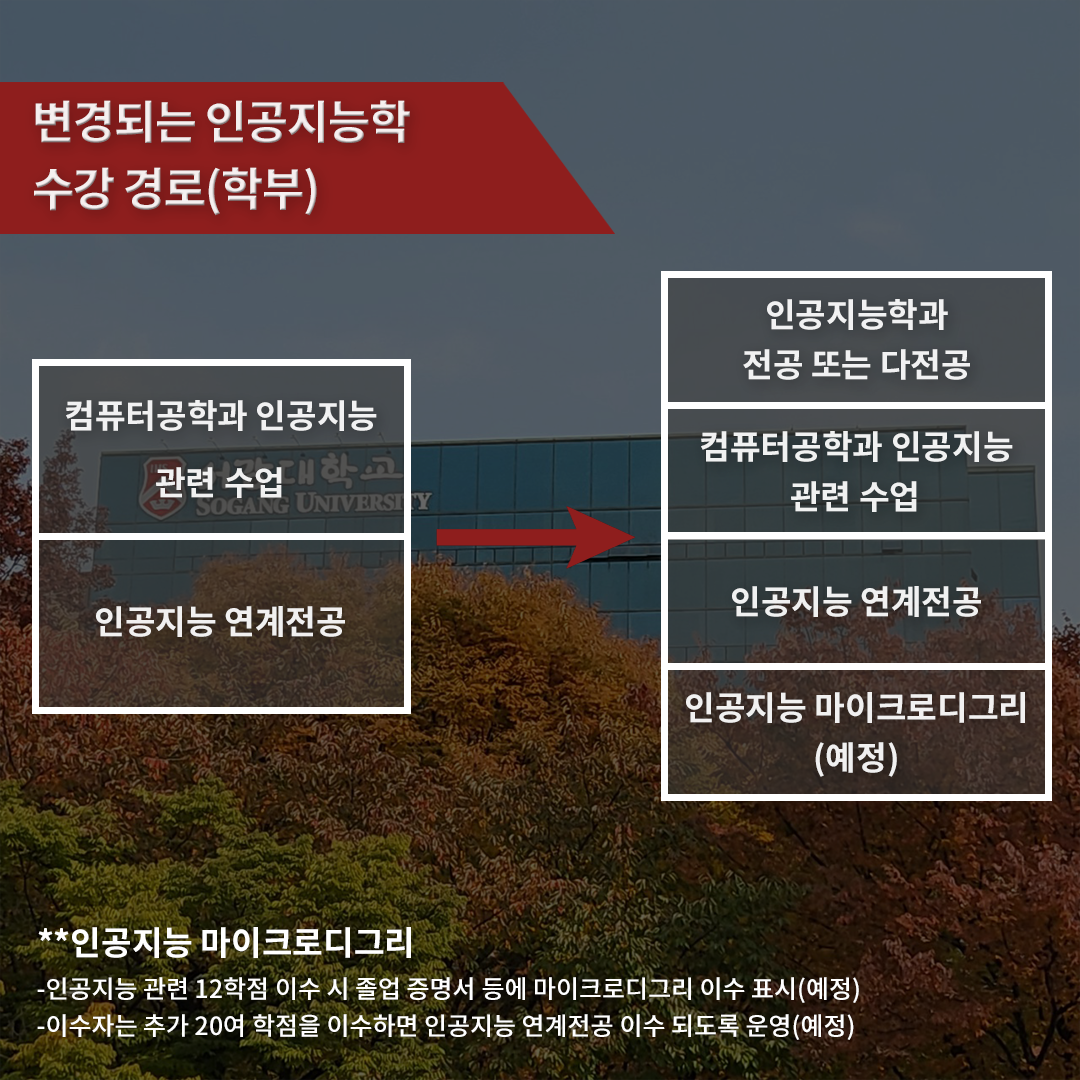
The AI micro-degree programme is currently at the planning stage at the University and is not yet in operation.
Professor Nang advised: "Students from other schools who are interested in artificial intelligence are encouraged to complete the AI interdepartmental major, the Big Data interdepartmental major or the Convergence SW interdepartmental major and then go on to the graduate Department of Artificial Intelligence."
[Expectation and concern are mixed over the new department, with questions and answers exchanged at October's Dialogue with the President]
Questions and answers about the Department of Artificial Intelligence were exchanged at the Dialogue with the President held for the natural sciences and engineering fields and the School of Media, Arts and Science. At the dialogue, Kim Seo-in, Vice President of the School of Engineering student council (Computer Science & Engineering '20), noted that "there have been classes in the Department of Computer Science & Engineering that were cancelled for want of faculty," and asked whether "if sufficient faculty are not secured when the Department of Artificial Intelligence is established, similar cases might recur or the effects might spill over into the Department of Computer Science & Engineering." If faculty are not secured, class sizes grow and the number of classes each professor teaches increases, which can lead to a decline in the quality of learning. Securing faculty is a chronic problem at Sogang, and concrete planning by the University appears necessary.
In response, Choi Jung-woo, Dean of the School of Engineering, said: "Last semester we added one professor in an AI-related area, and the Department of Computer Science & Engineering also hired two, so we are continuing to attend to faculty expansion," adding that "establishing a department and increasing student numbers is a matter of successive years, and we plan to secure faculty step by step." He also said: "Because this is a highly contested specialist field, recruitment of fully specialized AI faculty has not been completed and filling the planned positions is not easy, but we will keep working at it." Song Tae-kyong, Vice President for Academic Affairs, added: "Because the graduate programme is being created first and related faculty will be recruited for it, that should not be a worry," and "since AI-related courses are already offered in the Department of Computer Science & Engineering, we expect an environment in which students of both that department and the AI department can take courses in a mutually complementary way."
Concern was also raised that when the Department of Artificial Intelligence is established, "sharing the university funds and other budget allocated to the School of Engineering might reduce the budgets of other departments within the school and thus the budget allocated per student." Kim Gil-sun, Head of the Planning Office, explained: "Budget is fundamentally allocated according to the number of students in the school concerned, so there will be no change in the amount of support per student."
Meanwhile, a student who said they were interested in the AI interdepartmental major expressed concern about the future of that major once the Department of Artificial Intelligence is established — namely, whether the interdepartmental major might disappear given the similarity in character. Asked about this by this station, Professor Nang said: "Nothing has yet been decided as University policy," and "my personal view is that the AI interdepartmental major will continue to be run independently for undergraduates belonging to other majors."
Among students there is also worry that a situation like the "merger of the School of Media, Arts and Science" might recur. Two years ago the University came into considerable conflict with students in the course of merging the School of Knowledge Convergence and the School of Communication into the School of Media, Arts and Science, over issues including securing full-time faculty, confusion about departmental identity, inadequate infrastructure and the manner of communication. Hence the concern that the Department of Artificial Intelligence, too, might spring up as a fashion and later be merged with another department in the School of Engineering for financial or other reasons.
On this point, a student surnamed Son from the School of Communication argued: "To avoid the same problems as before, the identity of the new department must be made clear," and raised their voice to say that "departments proliferating or being abolished as a matter of fashion is never good from a student's point of view."
Alongside such concerns, posts asking about the new Department of Artificial Intelligence have appeared on the University's online community and posts covering news of related faculty hiring have drawn favourable responses — suggesting there is also expectation that the new department could help students respond to a rapidly changing employment environment.
Professor Nang explained: "Where the Ministry of Science and ICT's AI Graduate School support programme focuses on core technology in artificial intelligence itself, our Department and Graduate School of Artificial Intelligence are distinguished by 'convergence of artificial intelligence with other academic fields + a basis in industry demand'." He added: "A total of 35 professors will take part and we will focus on convergence education and research applying AI technology to other academic fields; we believe it was by composing a curriculum matched to industry demand that we were able to secure industry–academia cooperation with LG Electronics and Smilegate."
The University plans to establish research centres jointly with those companies and conduct industry–academia research, and hopes that through this the distinctiveness and competitiveness of its AI programmes and graduates will be recognized.
With concern and expectation thus following one after another over the establishment of the Department of Artificial Intelligence, it appears we should watch with interest whether the University can dispel students' concerns, meet their expectations, and introduce the department successfully.
[In Brief]
The University's Academic Support Team announced changes to class operations after the midterm examinations on the 20th. From after the midterms (27 October), classes will be run in line with the outcome of the 91st meeting of the COVID-19 response committee. For theory classes, blended in-person/remote instruction will be conducted only for courses that applied for in-person teaching at the start of the semester. Laboratory and practical classes in the sciences and engineering, and practical physical education classes, will be permitted to continue in person as before, within the bounds of the infection-control rules. In-person final examinations will be permitted only for classes that ran in blended in-person/remote form and for science and engineering laboratory and practical classes and practical physical education classes.
The grading method for second-semester final examinations and the winter session is being changed. By resolution of the 133rd Academic Affairs Committee, limited relative grading will be applied on a temporary basis for the second-semester finals and the winter session. The existing grade distribution limits for relatively graded courses change from 'A within 30%, A+B within 70%, C within 50%' to 'A limited to within 40%, with no lower limit'. Courses previously graded absolutely, which were exempt from relative grading, will be graded without change. Midterm examination grades will have the existing relative grading proportions applied.
[News in Brief]
The University's Career Support Team will begin running the 'Sogang Manhattan' career and employment talks in earnest. The programme is a forum for exchange with alumni working at financial public enterprises, organized jointly by the Career Support Team, the School of Business administrative team and the School of Economics administrative team. Beginning with a talk show with four alumni from the Financial Supervisory Service on 9 November, alumni from some nine financial public institutions will take part in the career and employment talks in November alone. Unlike other events, notices are available only through Sogang TokTok. Details can be found on the Career Support Team's website.
Temple University, a partner university of Sogang in the United States, will hold an online information session. It can be joined via Zoom at 9 p.m. on 3 November, and will cover a range of topics including scholarships, GRE waivers, internships and careers, and exchange study. Temple University is a state university located in Philadelphia, Pennsylvania, where business administration, journalism and broadcasting, and American culture are counted among the popular majors. It has had an exchange agreement with Sogang University since 2010, now in its eleventh year. Details about the session can be found in the notices on the University's International Team website.