

Regular Paper Accepted at the Outstanding International Conference ACM SAC (Operating Systems Track)
Files

Regular Paper Accepted at the Outstanding International Conference ACM SAC (Operating Systems Track)
(First author: Lee Jin-hoon; corresponding author: Professor Kim Young-jae)

▲ (From left) Lee Jin-hoon (master's student), Jung Yeon-woo (doctoral student),
(Bottom, from left) Safdar Jamil (combined master's–doctoral student), Kim Young-jae (corresponding author)
A paper titled 'MFence: Defending Against Memory Access Interference in a Disaggregated Cloud Memory Platform', written by graduate students Lee Jin-hoon (master's, 4th semester; supervisor: Professor Kim Young-jae), Jung Yeon-woo (doctoral, 6th semester; supervisor: Professor Park Sung-yong) and Safdar Jamil (combined master's–doctoral, 10th semester; supervisor: Professor Kim Young-jae) of the Department of Computer Science & Engineering under the supervision of Professor Kim Young-jae (corresponding author), has been accepted for publication at the ACM/SIGAPP Symposium on Applied Computing, Operating Systems Track, listed at an adjusted IF of 1 among the outstanding international conferences in computer science under the BK21 Plus programme. The paper proposes MFence, a cache partitioning mechanism that resolves the problem of unfair memory occupancy of shared cache between processes in VM-based disaggregated cloud memory platform environments. MFence is a kernel module supporting independently partitioned cache regions that completely eliminates cache interference between processes.
A VM-based disaggregated cloud memory platform is an architecture in which two or more nodes can borrow or lend one another's memory, improving application performance by increasing memory utilization and capacity. Because this architecture uses local memory on a given node as a cache and remote nodes as swap space (OS swap), cache contention arises within local memory. The paper proposes MFence, an architecture that prevents cache contention using two mechanisms, hypercall and gCR3.
MFence was shown to enable fair cache partitioning with low overhead and to bring performance gains. As a representative example, when aggregation and grep workloads ran simultaneously, cache partitioning through MFence yielded a 14.4% performance improvement.
Figure 1. Data structures and flow chart of the system proposed in this paper |
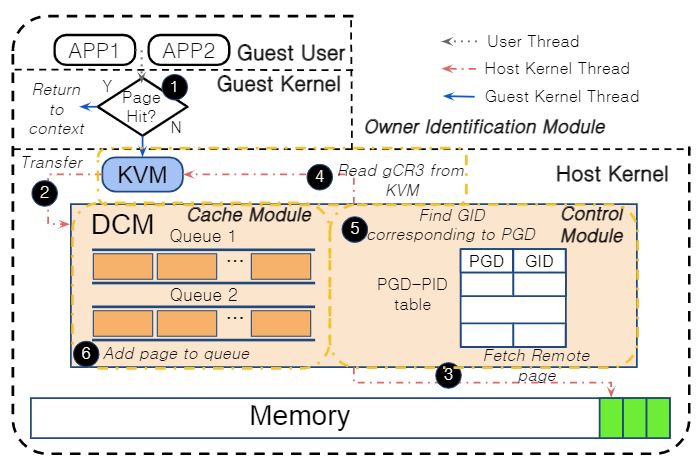
Figure 1 illustrates the data structures and flow chart of MFence's gCR3 mechanism. MFence operates through the interaction of three modules: the cache module, the owner identification module and the control module. The user first passes commands to the control module via an API to partition the local cache. On receiving the command, the cache module allocates a new queue corresponding to the local cache space and assigns it a unique group ID. It also maps applications to cache spaces so that a given application uses a cache space of the specified size.
After this setup, when a page fault occurs in an application, the faulting page is fetched from the remote node, the application owning the page is identified through the owner identification module, and the page is inserted into the appropriate queue.
The ACM/SIGAPP SAC conference is a distinguished international conference covering a wide range of computing fields. It will be held in Tallinn, Estonia, from 27 to 31 March next year.
References
ACM/SIGAPP SAC conference site: https://sigapp.org/sac/sac2023/
'MFence: Defending Against Memory Access Interference in a Disaggregated Cloud Memory Platform' paper: https://discos.sogang.ac.kr/file/2023/intl_conf/SAC_2023_J_Lee.pdf