

Best Paper Award at the Korea Software Congress 2022 (KSC 2022) — Big Data Processing and Database Laboratory
Files

The paper 'GCN-Based Time-Series Anomaly Detection Applying Per-Sensor Time-Lagged Cross-Correlation', by graduate student Lee Kang-woo of the Department of Computer Science & Engineering (supervisor: Professor Jung Sung-won), received the Best Paper Award at the 2022 Korea Software Congress (KSC 2022), held over four days from 20 to 23 December.
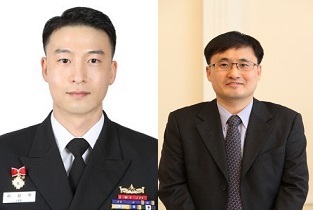
▲ From left: Lee Kang-woo (master's, 4th semester) and Professor Jung Sung-won (supervisor)
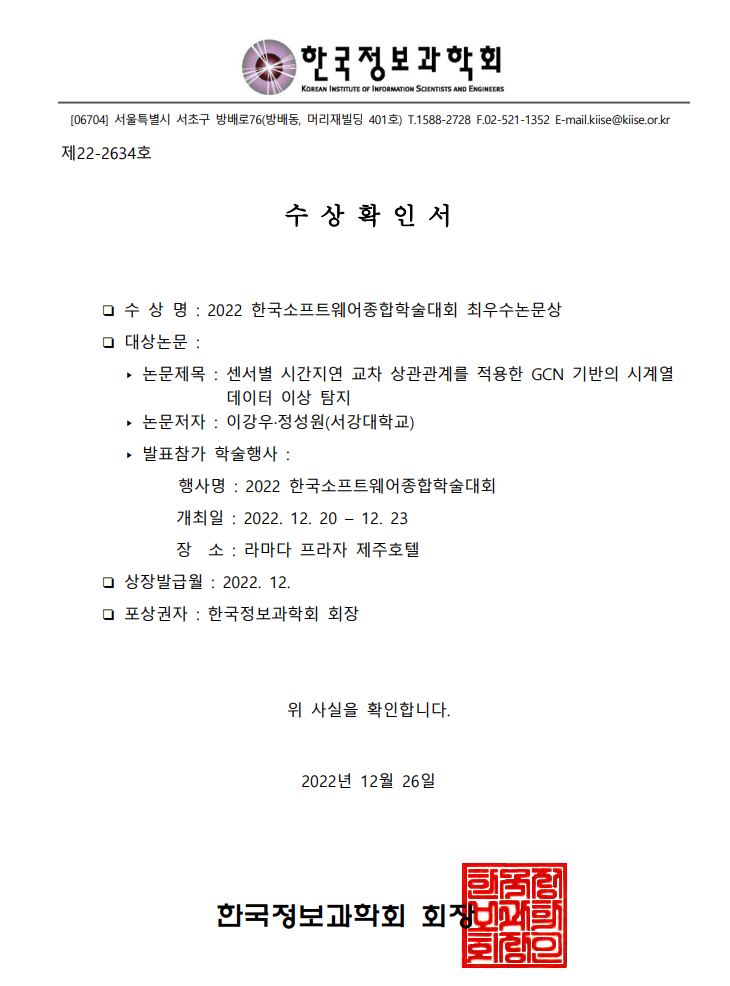
▲ Certificate of the Best Paper Award at the Korea Software Congress 2022 (KSC 2022)
In network management and security, industrial settings and elsewhere, equipment is monitored through the time-series data each sensor collects. Detecting equipment anomalies early through efficient time-series anomaly detection is therefore a very important task in these fields, since it prevents greater damage and contributes to productivity. Research on time-series anomaly detection has been active as deep learning has advanced recently, but the following limitations remain.
First, because only each sensor's own anomaly status is analysed without analysing correlations with other sensors, unnecessary false alarms occur. Second, although modelling as a complete graph with Graph Attention Networks (GAT) has been used to analyse inter-sensor correlations, this approach cannot reflect exact correlations and requires a great deal of analysis time because of the increase in unnecessary computation. To address these problems, this paper proposes SC-GCNAD (Sensor-specific Correlation GCN Anomaly Detection).
To resolve the above limitations, SC-GCNAD applies Time Lagged Cross Correlation (TLCC), which reflects the characteristics of time-series data, to analyse precise per-sensor correlations, and uses Graph Convolutional Networks (GCN), which express correlations well. It thereby converts the data into a graph structure reflecting only the essential correlations, shortening analysis time, and then detects anomalies in the time-series data through GRU and forecasting models. SC-GCNAD improves F1 score by up to 6.37% and reduces analysis time by up to 86.72% compared with existing models.
The 2022 Korea Software Congress (KSC 2022) is an information science and technology conference at which the latest research results across every area of information technology — artificial intelligence, computer systems, databases and more — are presented.