

Paper Accepted at the Distinguished International Workshop ACM HotStorage
Files

The research team of the Data-Centric Computing and Systems Laboratory
Papers Accepted at the Distinguished International Academic Workshop ACM HotStorage for Three Consecutive Years (2021, 2022, 2023)

▲ (Top row, from left) Byeon Seong-jin, undergraduate, Department of Economics / Department of Computer Science & Engineering; Noh Yo-seph, master's student
(Bottom row, from left) Safdar Jamil, combined master's–doctoral student, Department of Computer Science & Engineering; Professor Kim Young-jae, Department of Computer Science & Engineering
The paper 'A Free-Space Adaptive Runtime Zone-Reset Algorithm for Enhanced ZNS Efficiency', written by Byeon Seong-jin (undergraduate researcher), Noh Yo-seph (master's) and Safdar Jamil (combined master's–doctoral) of the Data-Centric Computing and Systems Laboratory in the Department of Computer Science & Engineering under the supervision of Professor Kim Young-jae, has been accepted at the distinguished international academic workshop The 15th ACM Workshop on Hot Topics in Storage and File Systems (HotStorage). The work was carried out in collaboration with Samsung Electronics (co-author: Kang Jung-wook).
The research proposes an algorithm for the zone reset command executed when running a log-structured merge-tree (LSM-tree) based key-value store on a Zoned Namespace SSD (ZNS SSD).
Optimizing LSM-tree based key-value stores (e.g. RocksDB) for ZNS SSDs is a topic that has recently attracted the attention of academia and many researchers. This study analyses ZenFS, RocksDB's well-known user-level file system, and points out its problems in particular.
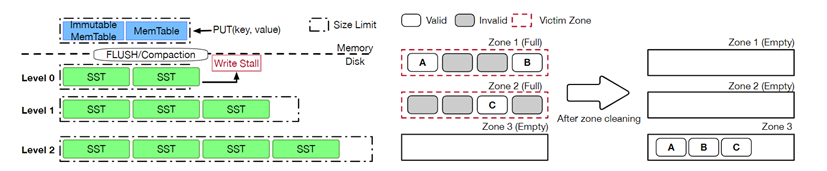
▲ RocksDB's LSM-tree structure (left) and the zone cleaning process in ZenFS (right)
The team first found that, besides 'zone cleaning' — host-managed garbage collection (GC) performed when the write pointer (WP) reaches the end of a zone — ZenFS also issues 'runtime zone-reset', which resets a zone immediately for performance reasons even though the WP has not reached the end of the zone. They pointed out that the current runtime zone-reset algorithm can reduce device lifetime, and analysed the trade-off between system performance and device lifetime according to the frequency and method of runtime zone-reset.
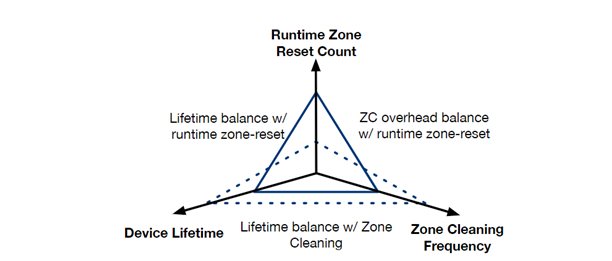
▲ Analysis of the trade-off between performance and lifetime under runtime zone-reset
The paper proposes a 'Free-Space Adaptive Runtime Zone-Reset' algorithm that minimizes the lifetime problem while guaranteeing maximum system performance. The algorithm performs runtime zone-reset adaptively on the basis of the free space within the device and a specific turning point. Experiments confirm that it roughly doubles the guaranteed device lifetime while maintaining performance.
ZNS SSDs, which emerged as a way of resolving the write amplification and over-provisioning problems caused by the inherent out-of-place update behaviour of SSDs, are next-generation storage devices that can eliminate the performance degradation caused by internal GC in conventional block-based SSDs. They are being actively discussed as candidates to replace block-based SSDs, and the FAR algorithm presented here is expected to offer deeper insight into the methods and effects of the zone reset command.
ACM HotStorage is a distinguished international academic workshop that reviews submissions on originality, technical merit and the potential to lead to insightful discussion influencing the design of future storage systems and applications. The workshop will be held in Boston, United States, on 9 July this year.
▶ Conference link: https://www.hotstorage.org/2023/
▶ Paper link: https://discos.sogang.ac.kr/file/2023/intl_conf/HotStorage_2023_S_Byeon.pdf