

Regular Paper Accepted at the Top International Conference European Conference on Computer Vision (ECCV) 2026
Files


The research paper 'Remembering Across Blocks: Topology-Conditioned Block-Progressive Memory for Skeleton-Based Action Recognition' by Lee Sun-ho and Cho Sung-in has been accepted as a regular paper at the European Conference on Computer Vision (ECCV) 2026, the most prestigious international conference in computer vision.
The paper addresses skeleton-based action recognition, which recognizes actions from sequences of human joint coordinates. Skeleton-based action recognition is an important area of computer vision research that must analyse body structure together with temporal motion information, and graph convolutional network (GCN) based methods have been widely studied in recent years.
Existing GCN-based methods treat joints as graph nodes and learn long-range dependencies by repeatedly performing one-hop message passing between adjacent joints. They also refine representations progressively through block-wise learned topology across several GCN blocks. Repeated graph aggregation, however, can cause over-smoothing, in which node features grow increasingly similar in deeper blocks. In addition, the fine-grained motion cues formed in early blocks can be diluted during subsequent aggregation and may not be sufficiently reflected in the final embedding.
To resolve these problems, the team proposes topology-conditioned block-progressive memory. The proposed method stores the complementary representation formed at each block along the GCN block axis in a memory, and fuses the accumulated memory state into the final embedding, thereby mitigating the representation degradation caused by repeated graph aggregation.
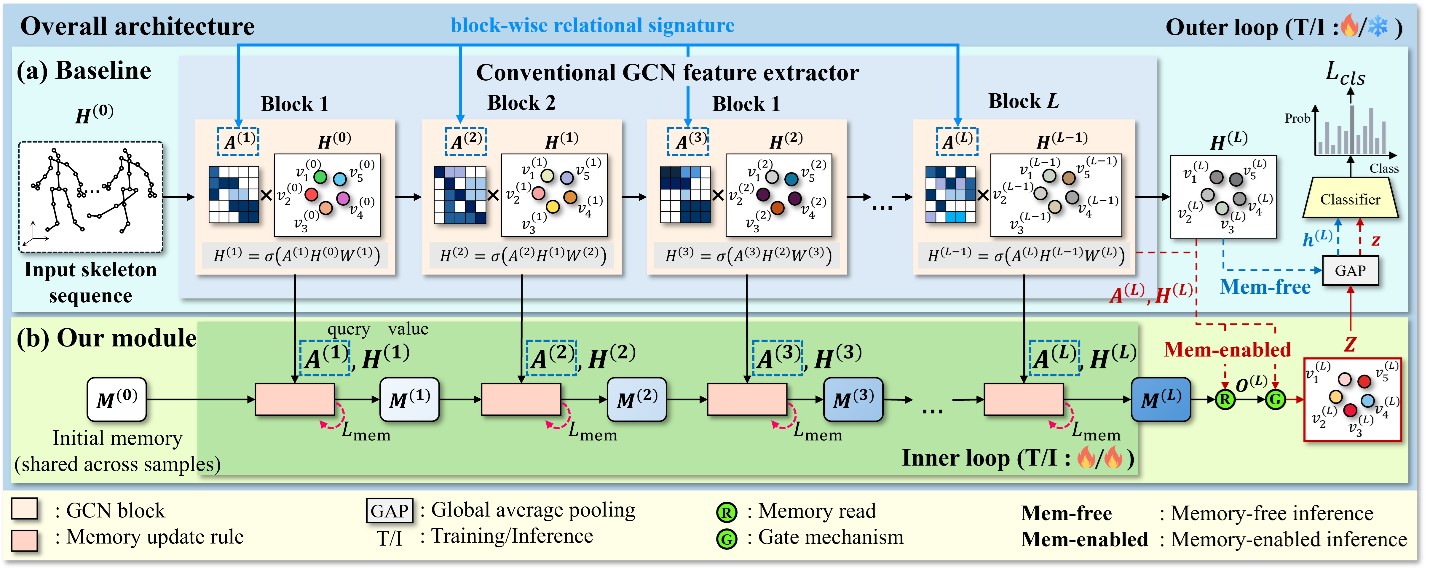
Figure 1. The overall architecture of the proposed method. (a) The baseline structure based on a conventional GCN feature extractor. (b) The proposed topology-conditioned block-progressive memory module.
The proposed memory module maintains a memory state unique to each sample and updates the per-block memory by minimizing a topology-conditioned reconstruction loss. The reconstruction error measures how well the previous memory explains the current block representation while also capturing newly emerging discriminative cues. The model can therefore exploit both the fine-grained joint representations and the structural information formed across several blocks, rather than relying on the representation of the final block alone.
The paper also supports two modes of operation at inference. Memory-free mode uses the memory module only during training and performs inference at test time without any additional memory update, while memory-enabled mode applies the same memory update rule at test time as well to obtain a further performance gain.
In the experiments the proposed method achieved state-of-the-art performance on large-scale skeleton-based action recognition benchmarks including NTU RGB+D, NTU RGB+D 120 and Kinetics-Skeleton. This shows that remembering the useful representations formed at each GCN block and using them for the final recognition is effective in improving skeleton-based action recognition.
Together with CVPR and ICCV, ECCV is one of the top international conferences representing the field of computer vision, and a prestigious venue at which the latest research results across computer vision are presented. ECCV 2026 will be held in Malmö, Sweden, from 8 to 12 September 2026.
[References]
Paper title: Remembering Across Blocks: Topology-Conditioned Block-Progressive Memory for Skeleton-Based Action Recognition
Authors: Lee Sun-ho (first author, Sogang University), Han Sang-hoon (co-author, Sogang University), Nam Hyuk (co-author, Sogang University), Cho Sung-in (corresponding author, Sogang University)
The European Conference on Computer Vision (ECCV) 2026 website: https://eccv.ecva.net/
Lab homepage: https://sites.google.com/view/csi2267svm/