

Full Research Paper Accepted at the Top International Conference ACM International Conference on Information and Knowledge Management (CIKM) 2026
Files

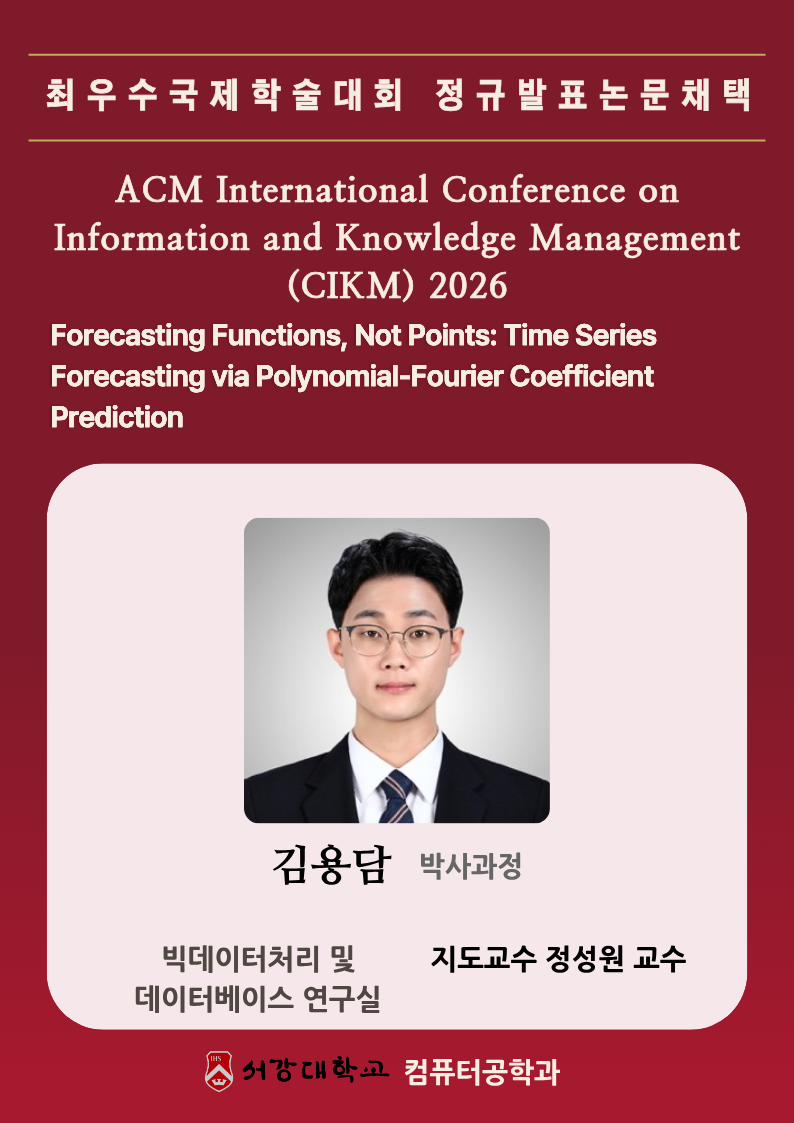
The paper 'Forecasting Functions, Not Points: Time Series Forecasting via Polynomial-Fourier Coefficient Prediction', written by Kim Yong-dam (doctoral, first author), Yang Jun-seong (master's), Park Hyun-ji (master's) and Professor Jung Sung-won (corresponding author) of the Bigdata Processing & DB Lab, has been accepted for publication as a full research paper at the top international conference ACM International Conference on Information and Knowledge Management (CIKM) 2026 (acceptance rate: 597/2216 = 26.9%).
Long-term forecasting of the time series produced by environmental sensors — weather observation, air quality measurement, hydrological observation — feeds directly into decisions such as climate response, public health and disaster early warning. Long-term time series forecasting models to date, however, almost all use the same structure: point forecasting, which emits one value for each future time step. In this approach the size of the output layer grows in proportion to the forecast horizon and, above all, the forecast is tied to the temporal resolution used in training. If a model trained on hourly data is then needed for 10-minute forecasts, there is no option but to retrain it from scratch.
The team approached the problem by changing the form of the forecast itself. Instead of predicting future values one by one, it predicts the coefficients of a continuous function that describes the future. The function CoefNet predicts consists of a 5th-order polynomial term and eight Fourier harmonic terms, and the model emits just 21 coefficients per channel through a single linear projection. The polynomial terms handle the trend and the Fourier terms the periodicity, so the structure of the signal is already built into the output form, enabling effective forecast modelling.
Because predicting a function allows values to be read off directly on grids never seen in training, the output size shrinks by up to 34 times for a 720-step forecast. A single global function alone, however, misses the local variation that changes within the forecast horizon, so the team also designed a mechanism that divides the horizon into small sub-windows and slightly corrects the shared coefficients with a low-rank modulation. The added parameters amount to about 4%, and this approach improved overall mean MSE by 5.8%.
The experiments covered four environmental sensor datasets — Weather, AQShunyi, AQWanliu and CzeLan — and four forecast horizons, against nine state-of-the-art forecasting models. CoefNet recorded the lowest MSE in 13 of 16 settings, and the performance gap widened as the forecast horizon grew. In an experiment evaluating a model trained at 20-minute intervals directly at 10-minute intervals without retraining or interpolation, performance degraded little; conversely, on noisy air quality data there were even ranges where the error decreased.
The research shows that a model trained once can be reused across a variety of operating conditions, breaking with the established practice of retraining whenever the forecast horizon or temporal resolution changes.
Kim Yong-dam, the paper's first author and a doctoral student, said: "There has been a great deal of research on making time series forecasting models more sophisticated, but little that asks again what the model should output. Changing it to predict a function rather than points naturally dissolved the constraints tied to forecast horizon and resolution, and we confirmed that just 21 coefficients can surpass state-of-the-art models. Going forward I plan to extend this to data with many channels and to use the predicted trend and periodic coefficients themselves as a means of explaining the basis for a forecast. I am grateful to my fellow master's students Yang Jun-seong and Park Hyun-ji, who worked on this with me, and to Professor Jung Sung-won for his guidance."
The ACM International Conference on Information and Knowledge Management (CIKM) is a globally prestigious international conference covering information retrieval, knowledge management, data mining, databases and artificial intelligence. CIKM is listed at a recognized IF of 3 among the outstanding international conferences in computer science under BK21, and is classified as a top conference in the Korean Institute of Information Scientists and Engineers' list of outstanding conferences in the software field. This year it will be held in Rome, Italy, from 7 to 11 November.
References:
- 35th ACM International Conference on Information and Knowledge Management (CIKM 2026)
- Website: https://cikm2026.diag.uniroma1.it/