

Regular Paper Accepted at the Top International Conference ACM International Conference on Information and Knowledge Management (CIKM) 2026
Files

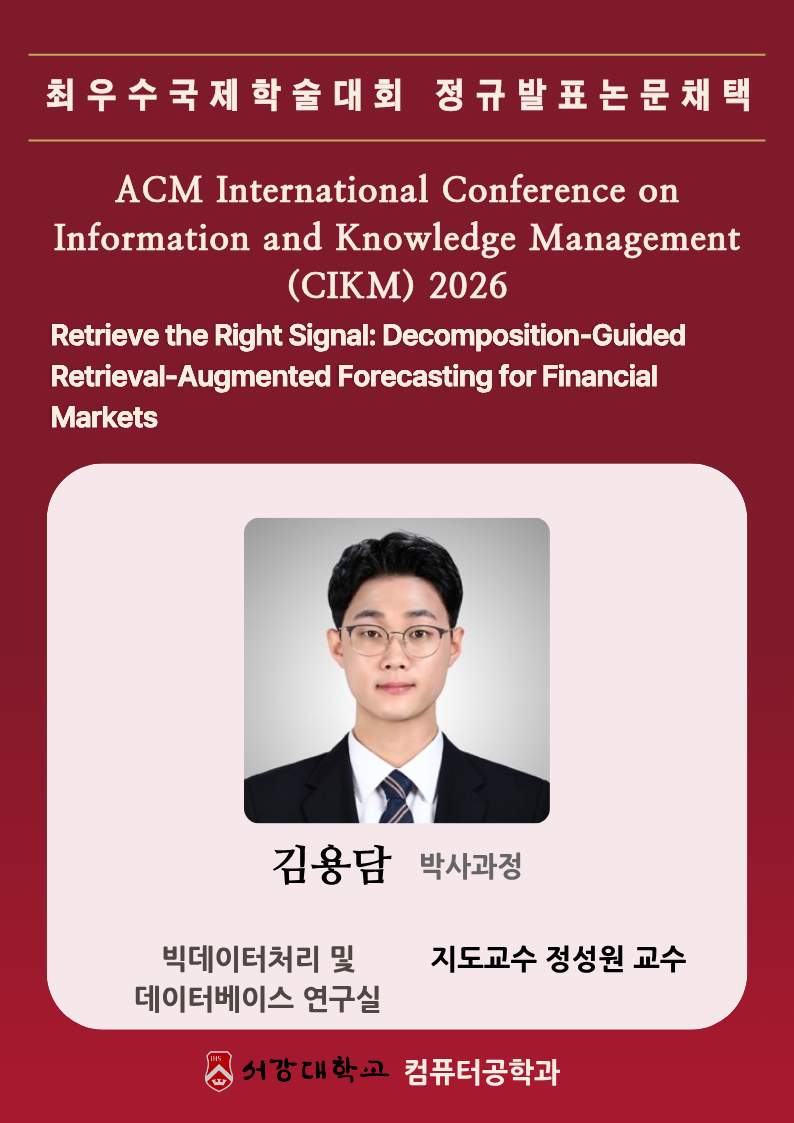
The paper 'Retrieve the Right Signal: Decomposition-Guided Retrieval-Augmented Forecasting for Financial Markets', a joint work by Kim Yong-dam (doctoral, first author), Park Hyun-ji (master's) and Professor Jung Sung-won (corresponding author) of the Bigdata Processing & DB Lab together with Lee Dong-woo (master's), Cho Jung-sun (master's), Lee Ye-in (master's) and Professor Yang Ji-hoon of the Machine Learning Research Lab, has been accepted for publication as a full research paper at the top international conference ACM International Conference on Information and Knowledge Management (CIKM) 2026 (acceptance rate: 597/2216 = 26.9%), and was selected for oral presentation.
Financial time series forecasting is the starting point for portfolio construction, risk management and investment strategy design, but unlike electricity or weather data it has almost no stable periodicity and its character changes greatly with the macroeconomic regime. In such conditions, retrieval-augmented forecasting — finding past segments similar to the present and referring to what actually happened next — is a compelling alternative, because similar market situations really do repeatedly lead to similar responses.
The problem lies in the criterion by which two segments are judged 'similar'. Existing methods compute similarity directly on the raw signal, but in financial data that similarity is dominated by price level and trend. As a result, segments that look very much alike can be followed by movement in exactly the opposite direction. The team confirmed such failures directly on the S&P 500: neighbours retrieved on the raw signal had a higher correlation coefficient but the subsequent direction diverged from the ground truth, while neighbours retrieved after removing the trend had a lower correlation coefficient yet matched in direction.
RISE, proposed by the team, uses decomposition as the criterion for splitting the forecasting path. It divides the input into a trend and a detrended component with a causal moving average that never references future values, then has a linear predictor handle the trend and performs retrieval on the detrended component. Rather than merely adding the retrieval result to the final forecast, it turns it into RAC (Retrieval-as-Context) tokens fed into a patch transformer encoder. The design lets retrieved information influence the representation learning stage as well as the output stage, and the added parameters amount to only 3.8K–23.8K. The forecasts of the three paths are combined with learnable weights.
Performance was verified along two lines. Across 48 settings — eight real financial datasets including the US, Japanese, Hong Kong and German stock indices plus gold, EUR/USD and Bitcoin, with six forecast horizons — RISE ranked first in 23 settings on both MSE and MAE, well ahead of other state-of-the-art models. On the NASDAQ and NYSE datasets of the public benchmark TFB it also ranked first in seven of eight MSE settings. In a diagnostic experiment varying only the retrieval criterion, retrieving in the detrended space raised directional accuracy from 0.537 to 0.560 and was superior on seven of eight datasets. Since the two approaches were almost identical in error magnitude, the result shows that decomposition contributes precisely on directionality.
Kim Yong-dam, the paper's first author and a doctoral student, said: "This research confirms that what matters in retrieval-augmented forecasting is not how much you retrieve but which signal you retrieve on. Retrieving in a space with the trend removed barely changes the error itself but improves the ability to get the direction right, and that difference matters a great deal in real financial forecasting. Going forward I plan to pursue learning the decomposition filter per asset and extending to intraday and microstructure forecasting. I am grateful to my fellow master's students Park Hyun-ji, Lee Dong-woo, Cho Jung-sun and Lee Ye-in, who worked on this with me, and to Professor Yang Ji-hoon and Professor Jung Sung-won for their guidance."
The ACM International Conference on Information and Knowledge Management (CIKM) is a globally prestigious international conference covering information retrieval, knowledge management, data mining, databases and artificial intelligence. CIKM is listed at a recognized IF of 3 among the outstanding international conferences in computer science under BK21, and is classified as a top conference in the Korean Institute of Information Scientists and Engineers' list of outstanding conferences in the software field. This year it will be held in Rome, Italy, from 7 to 11 November.
References:
- 35th ACM International Conference on Information and Knowledge Management (CIKM 2026)
- Website: https://cikm2026.diag.uniroma1.it/