

Regular Paper Accepted at the Top International Conference Advances in NeurIPS 2026
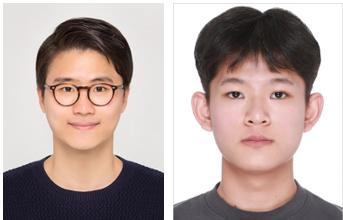
▲ (From left) Professor Seongin Cho, Master's student Giyeon Park
The paper "The Quiet Prompt: Erasing Ineffable Styles from Diffusion Models via Concept Leakage-aware Negative Guidance," authored by Kiyeon Park (first author) and Professor Seongin Cho (corresponding author) of the Smart Vision & Media (SVM) lab in the Department of Artificial Intelligence at our university, was accepted for a poster presentation at NeurIPS 2026, a leading international conference in the field of artificial intelligence.
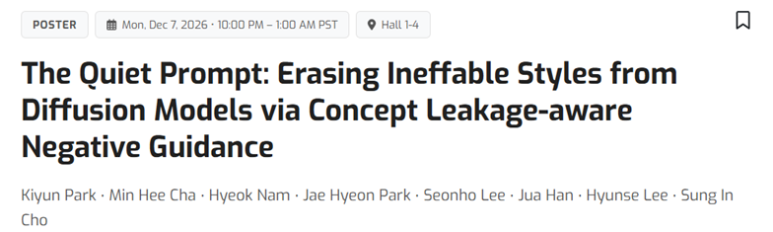
▲ NeurIPS 2026 Poster Paper Introduction Page
This paper proposes a Concept Erasure technique for a pretrained Text-to-Image Diffusion Model that suppresses the generation of unwanted concepts such as specific art styles, objects, or harmful content. Because large-scale diffusion models are trained on unrefined web data, there is a risk of directly imitating copyrighted artworks or personal images. Existing concept removal techniques specify the target to be removed using a text prompt, but this method fails to adequately capture artistic styles that are difficult to describe precisely in words, such as color, texture, and form. Moreover, as the descriptions grew longer, text embeddings varied greatly depending on small differences in word choice or word order, making it difficult to maintain consistency even within the same writing style. In addition, the existing negative prompting applies a fixed-size negative guidance at every denoising stage. As a result, at the stage where the target concept appeared strongly, suppression was insufficient, while at the stage where it appeared almost not at all, the generation path was unnecessarily altered, causing damage to object shape, arrangement, and background structure.
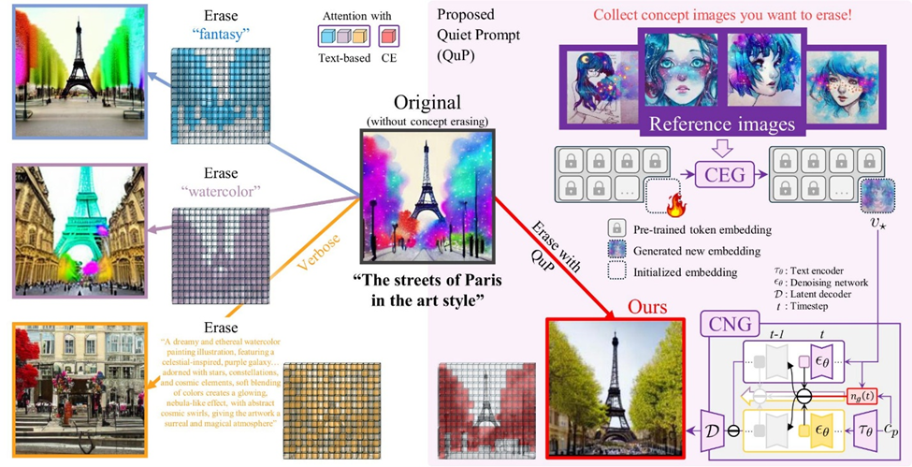
▲ Comparison between the text-based concept removal technique (left) and the proposed reference-image-based concept removal technique, Quiet Prompt (QuP) (right): The text-based method either fails to accurately identify the target style domain or leaves the style behind, even when the target is specified by words or a lengthy description. In contrast, QuP removes target image style using concept embeddings (CEG) generated from reference images and concept leakage-aware negative guidance (CNG).
The proposed method, Quiet Prompt (QuP), consists of two steps. The first step is Concept Embedding Generation (CEG), where the visual characteristics of the concept to be removed are represented as a single learned token embedding using fewer than 10 reference images. Since the weights of the diffusion model are fixed during this process, there is no need to retrain or modify the model. The second step is the concept leakage-aware negative guidance (CNG) stage, which uses the trained embeddings as negative conditions during inference. At each denoising stage, the degree and magnitude of concept leakage are measured using the cosine similarity between the intermediate estimate and the concept embeddings, and the intensity of the negative guidance is adjusted per timestep based on these measurements. This ensures that suppression is strengthened only when the target concept is strongly present, while preserving the generation path according to the input prompt to effectively remove only the concept to be eliminated. Because QuP applies the diffusion model without retraining, it operates across various backbones and achieved better quantitative and qualitative performance than existing methods in experiments for removing art style, objects, and harmful content.
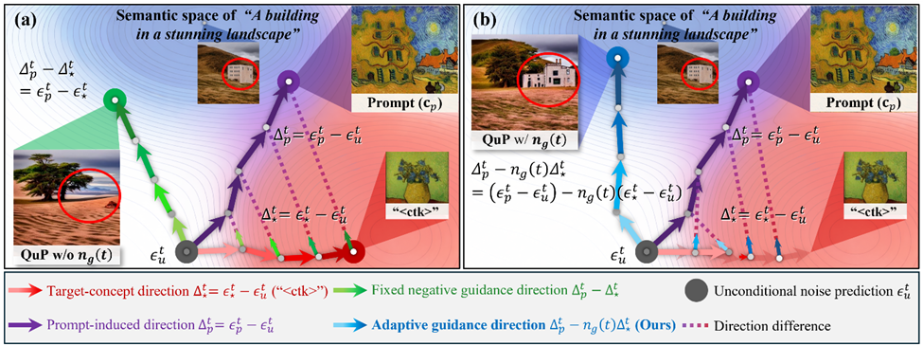
▲ Comparison of the denoising paths of fixed-size negative guidance (a) and the proposed concept leakage-aware negative guidance (b): In fixed-size guidance, the target image's architectural structure disappears along with the removed text. In contrast, the proposed technique removes the target’s painting style while preserving the building’s structure.
NeurIPS (Conference on Neural Information Processing Systems) is the world’s most prestigious conference in the fields of artificial intelligence and machine learning, evaluating research based on originality, technical contribution, reproducibility, and academic and industrial impact, and is composed of the Main Research Track, Evaluations & Datasets, Workshops & Tutorials, Competitions, and an Industry Expo. NeurIPS 2026 will be held primarily in Sydney, Australia (December 6–12), with official satellite events taking place in Atlanta, USA (December 8–13) and Paris, France (December 9–13). This paper is scheduled to be presented in a poster session on December 8 of this year (local time).
References:
NeurIPS 2026 website: https://neurips.cc
Paper's hyperlink: https://neurips.cc/virtual/2026/loc/sydney/poster/151233