

Regular Paper Accepted at the Top International Conference Advances in NeurIPS 2026
Professor Kim Young-jae's research team, Department of Computer Science,
Selected as a Regular Presentation Paper for the Best International Conference, NeurIPS 2026

Professor Youngjae Kim (Department of Computer Engineering) and doctoral student Farid Talibli (Department of Computer Engineering, supervised by Professor Youngjae Kim).
Professor Youngjae Kim (corresponding author) and PhD student Farid Talibli (first author) from the DISCOS (Data-Centric AI Computing and Systems) Laboratory at Sogang University's Department of Computer Science, together with co-authors Awais Khan and Christopher Zimmer (Oak Ridge National Laboratory), and Professor Sungyong Park and Professor Jihoon Yang, have published a paper at NeurIPS 2026, the world’s leading international conference in artificial intelligence (Acceptance Rate: 7,900/30,709 = 25.7%; 7,496 posters, 292 spotlights, and 112 orals). The paper, titled "When Must AI Training Stage Checkpoints? A Distributional Model of Durability Boundaries at Scale," analyzes when checkpoints are actually stored securely (durable) during AI training and studies methods to reduce the amount of training progress that can be lost due to rollback when failures occur by selecting appropriate storage paths.
Training large-scale AI models requires massive computing resources over long periods. To preserve training progress, the learning system periodically stores checkpoints containing model parameters, optimizer state, and the information needed to resume computation after a failure. With asynchronous checkpointing, training can continue while checkpointing is being stored in the background. However, just because control is returned to the learning program does not mean that the latest checkpoint has been saved in a state that is immediately safe for use in fault recovery.
This study focuses on the gap between the checkpoint completion time recognized by the application and the time when the actual training progress is safely protected. If a failure occurs before the required checkpoint data is stored securely, training must resume from an older checkpoint, and previously performed operations may need to be repeated. In addition, because shared storage performance can vary greatly depending on resource contention with other workloads, it is difficult to predict in advance how long exposure to these risks will last.
The research team also presented a conditional criterion for comparing the methods of writing checkpoints directly to a shared file system and replicating them to a partner node's local storage. In low-load shared storage scenarios, writing directly to the file system may be more advantageous, but when checkpoint completion is delayed due to contention, replication to the partner node can provide a faster point of data durability. Therefore, the purpose of this study is to determine which circumstances make it effective to use an alternate storage path rather than replacing the shared file system in all cases.
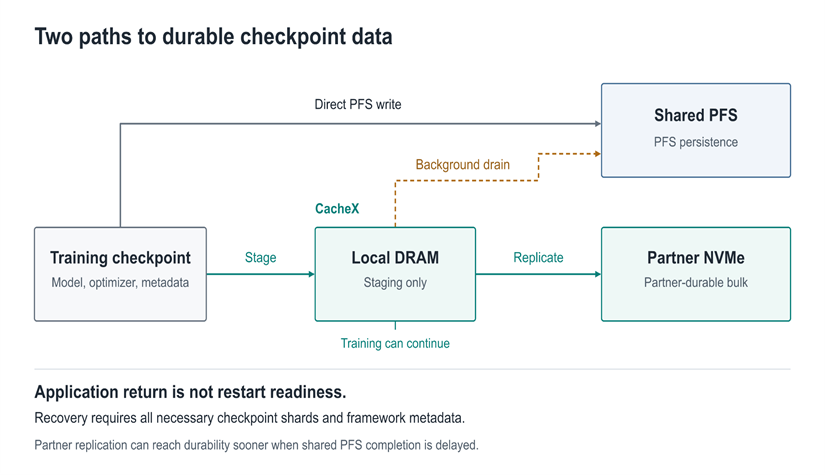
To implement this, the research team developed CacheX, a storage layer that operates transparently within PyTorch Distributed Checkpoint. CacheX first stores checkpoint data in local memory, then replicates it to the partner node's NVMe storage, and subsequently transfers the data to the shared file system. Because it uses the existing file interface, these new storage paths can be utilized without changing the application's checkpointing code.
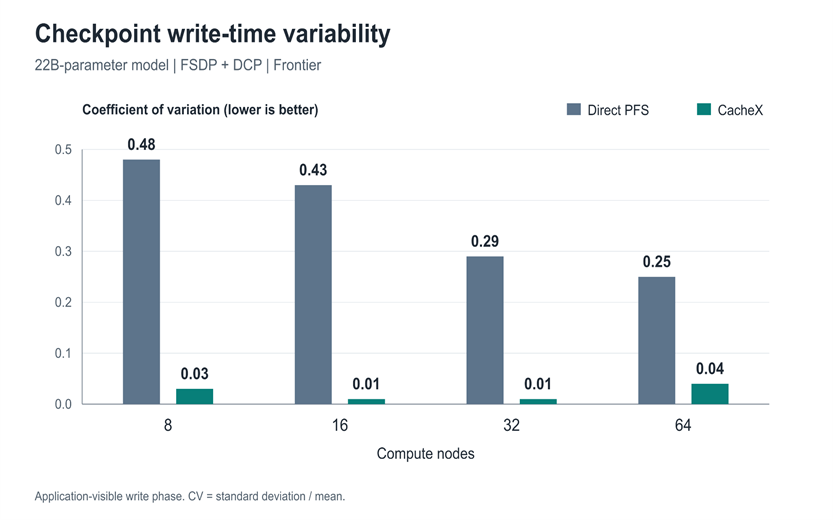
Performance evaluation was conducted using the U.S. Frontier supercomputer, KISTI's Neuron system, and checkpoints generated during real distributed AI training. Experimental results showed that CacheX reduced the coefficient of variation in checkpoint write times by up to 43 times on the evaluated workloads, delivering more consistent and stable write performance. In a separate validation experiment, the average mean absolute percentage error (MAPE) of the average completion time for a typical writer in a large-scale environment was predicted to be 7.1%. However, these prediction results pertain to general completion times and do not imply the ability to predict rare extreme stragglers in advance.
The recoverability of real AI training conditions was also verified through a failure injection experiment. The research team forcibly terminated the learning process of the host responsible for checkpoint metadata, deleted that host's local CacheX data, and even disabled the fallback function using the shared file system. Even under these conditions, we were able to obtain all 32 checkpoint shards and the full framework metadata through replicas stored on the survivor and partner nodes, and used this to restore the model and optimizer states properly and successfully resume AI training.
This study shows that reducing dropout time caused by checkpoints and protecting completed learning progress from disruption are related issues, but they must be distinguished. The study's main contributions lie in presenting an analytical framework for understanding the data durability boundary of checkpoints, a model for selecting appropriate storage paths depending on the context, and a system validated in real distributed AI training environments. This provides a way to evaluate checkpointing policies in real large-scale AI training systems by considering not only the performance experienced by the application but also the amount of training progress that could be lost in the event of a failure.
References
NeurIPS (Conference on Neural Information Processing Systems) is a leading international conference in the fields of artificial intelligence and machine learning.
NeurIPS: https://neurips.cc/
Data-Intensive AI Computing & System Laboratory (DISCOS Lab): https://discos.sogang.ac.kr