

First Prizes Won in Two Hackathons on the Use of AI Training Data
Files

The research team of Professor Koo Myoung-wan, Graduate Department of Artificial Intelligence,
Wins First Prize in Each of Two Hackathons on the Use of AI Training Data
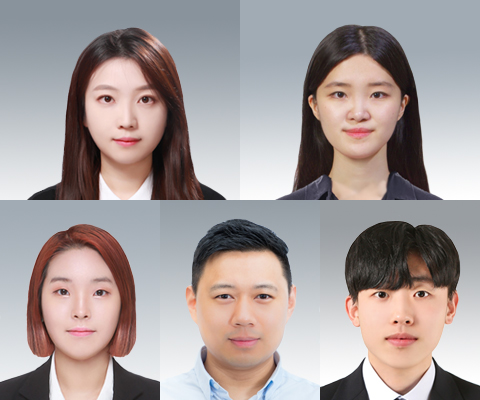
▲ (Top row, from left) Baek Ji-soo and Lee Ji-hyun, master's students
(Bottom row, from left) Choi Ye-rin, Lee Jung-pil and Jang Jae-hoo, master's students
Master's students in the Graduate Department of Artificial Intelligence belonging to the Intelligent Spoken Dialogue Systems Laboratory (ISDS), supervised by Professor Koo Myoung-wan of the Department of Computer Science & Engineering (and the Graduate Department of Artificial Intelligence), each won first prize in two hackathons on the use of artificial intelligence (AI) training data hosted by the Ministry of Science and ICT and the National Information Society Agency (NIA).
Master's students Baek Ji-soo and Lee Ji-hyun of the Graduate Department of Artificial Intelligence (team name 'ISDS') received the top Gold Prize and 1 million won in prize money at the Hackathon on the Use of AI Training Data from Korean Speech Data of Western- and Asian-Language Speakers for Language Education (the 'Foreign Speaker Korean Speech Hackathon'). They took first place among ten competing teams in the second-round assessment (final) held at Seoul National University on Friday 18 November.
Baek Ji-soo and Lee Ji-hyun proposed a method of automatically analysing phoneme error patterns by the native language of Korean learners, using SCTK, a widely used tool for evaluating speech recognizer performance. They also applied this methodology to analyse the phoneme errors that frequently appear according to foreign learners' native languages, and demonstrated through testing that the results were statistically significant. They received high marks for further proposing that the approach could be used for pronunciation training tailored to foreign learners by Eastern and Western language group.
Baek Ji-soo and Lee Ji-hyun come from humanities backgrounds, having majored in Japanese language and literature and in linguistics respectively as undergraduates, and entered the Department of Artificial Intelligence in its first cohort in the first half of this year. Baek Ji-soo said: "I feel proud that we were able to create a synergy by combining the foreign language and linguistics knowledge I acquired as an undergraduate with the engineering knowledge I have learned at graduate school," adding: "I will continue to broaden my academic horizons with a wide perspective."
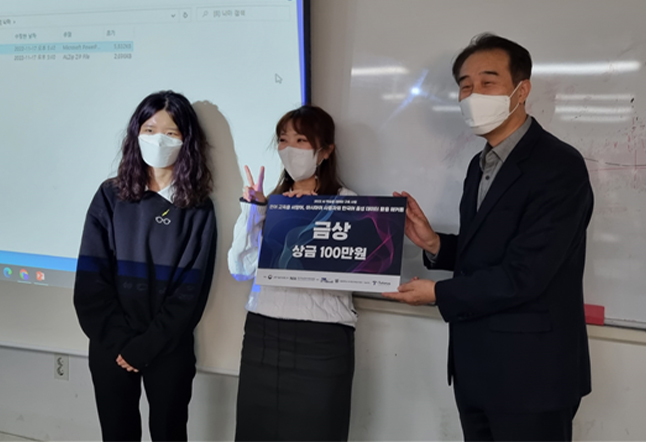
▲ Lee Ji-hyun and Baek Ji-soo, master's students in the Department of Artificial Intelligence (left and centre)
Commemorative photograph from the award ceremony for the Hackathon on the Use of AI Training Data from Korean Speech Data of Western- and Asian-Language Speakers for Language Education (18 November)
Lee Jung-pil, Lee Ji-hyun, Jang Jae-hoo and Choi Ye-rin from the same laboratory (team name 'Code Zero') won the Grand Prize and 2 million won in prize money in Field 2 (commercialization using AI Hub training data) of the AI Hub Training Data Hackathon. They took first place among 17 teams by proposing a framework capable of automating quality measurement and improvement for vast Korean speech datasets, and the award ceremony was held at the Gwangju CGI Centre on Tuesday 22 November.
Team Code Zero proposed a method of cleaning speech data with minimal human effort, using a high-performance pronunciation-based speech recognizer. Speech data is generally so voluminous that manual cleaning is difficult, making quality control a challenge. Using the training data of 'KSponSpeech', a Korean everyday conversation speech dataset among the AI Hub open datasets, the team developed a pronunciation-based speech recognition model with a character error rate of 8–9% on the test set. They further demonstrated the effectiveness of the methodology by using the model in a human-in-the-loop approach — in which a person gives feedback to AI training — to filter out 178 annotation errors (5.9%) from 3,000 test set items.
Lee Jung-pil said: "In this competition I thought hard about ways of commercializing AI using AI Hub open data," adding: "I came to appreciate that ideas matter, but so does the technology for the data processing and model training that match them."
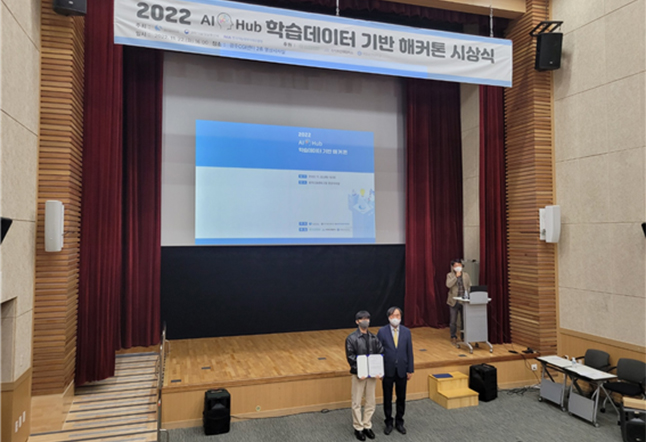
▲ Jang Jae-hoo, master's student in the Department of Artificial Intelligence (left)
Commemorative photograph from the award ceremony for the AI Hub Training Data Hackathon (22 November)